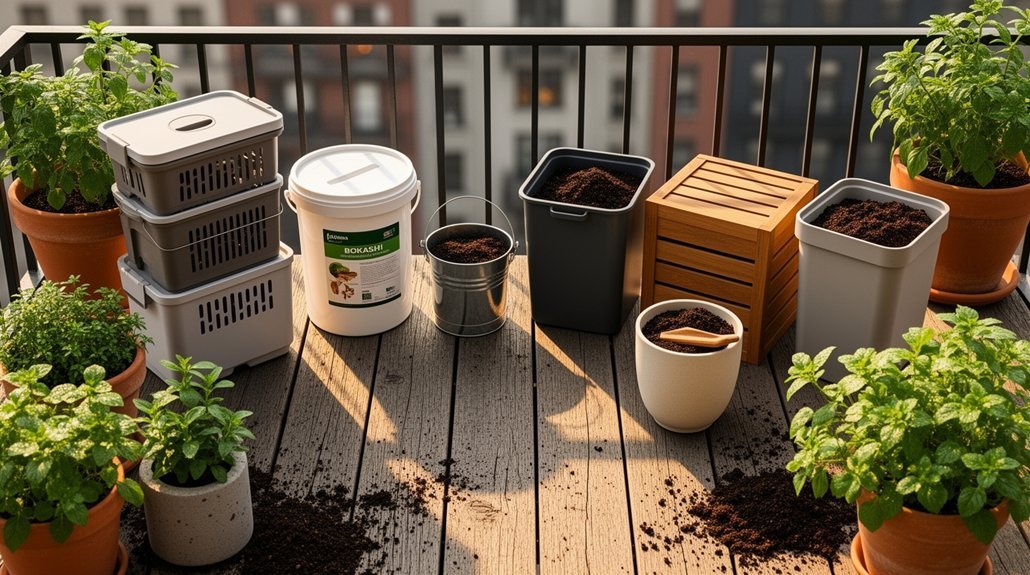
You can transform food scraps into nutrient-rich compost using seven container methods designed for apartments. Vermicomposting uses worms in stacked bins, while Bokashi fermentation handles meat and dairy indoors. Electric countertop composters deliver finished results in hours. Tumbling barrels speed decomposition through aeration, and vertical worm bins maximize tight spaces. You’ll also discover how to choose the right method for your needs and explore community composting as a backup option when space constraints limit your choices.
Vermicomposting: Worms That Work in Your Apartment
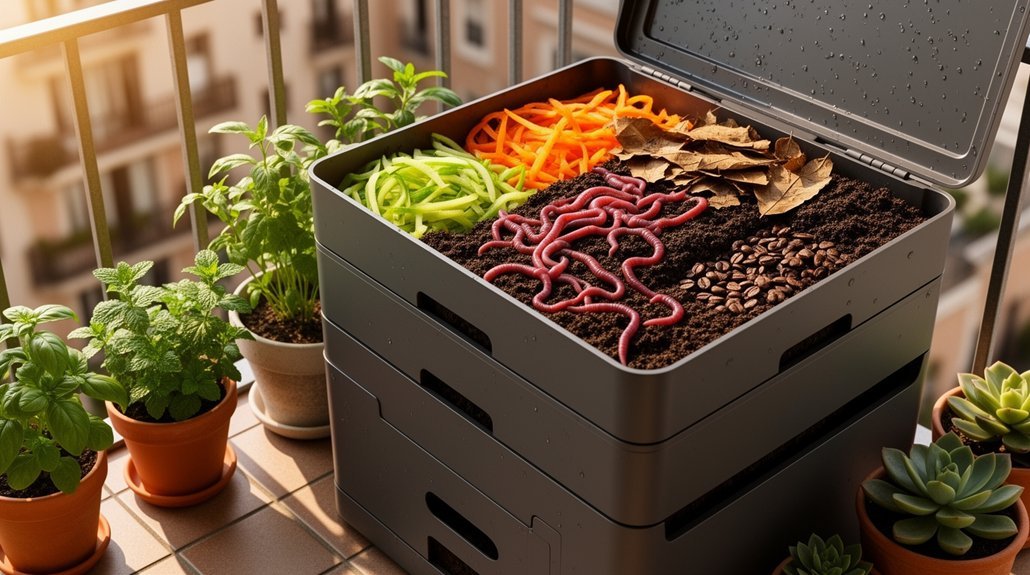
How can you transform kitchen scraps into nutrient-rich compost without leaving your apartment? Vermicomposting offers a compact solution using red wigglers to break down food waste into valuable castings.
Vermicomposting transforms kitchen scraps into nutrient-rich compost using red wigglers, offering a compact apartment solution for breaking down food waste into valuable castings.
You’ll need two plastic containers with ventilation and drainage holes, shredded newspaper bedding, and worms. Bury fruit and vegetable scraps under moistened bedding to minimize odors and flies. Avoid meat, dairy, and oily foods.
Maintain damp (not wet) conditions and avoid overfeeding. Red wigglers convert your scraps into dark, crumbly compost ready for houseplants and balcony gardens. However, neighbor complaints about odors can arise if the bin is not properly maintained, particularly in shared apartment buildings. Consider using removable containers with handles to easily relocate your vermicomposting system if odor issues develop.
The payoff? You’ll reduce landfill waste while creating a low-odor indoor system that fits in closets, corners, or utility areas. Consistent upkeep ensures success.
Bokashi Fermentation: Process Meat and Dairy Indoors
You’ll find that bokashi fermentation works through anaerobic digestion, where layered food scraps and inoculated bran ferment in a sealed, oxygen-free environment that naturally suppresses odors and pest problems.
By compressing your scraps tightly and draining leachate regularly through the spigot, you maintain the low-moisture, high-acid conditions that keep your indoor bucket manageable and pleasant. The fermentation process typically requires about two weeks of sealed storage away from direct sunlight before your waste is ready for garden integration. Many urban composters choose bokashi starter kits that include both bins and bran to ensure consistent fermentation results.
This sealed-bucket method proves especially effective for processing meat, dairy, and cooked foods that’d normally create issues in traditional compost systems.
How Bokashi Fermentation Works
What makes bokashi different from traditional composting? You’re using anaerobic fermentation instead of aerobic decomposition. Here’s how it works:
- Layering and inoculation: You add food scraps in layers to a sealed bucket, sprinkling inoculated bran between each layer. The bran contains lactobacilli, yeast, and beneficial microorganisms that kickstart the process.
- Rapid fermentation: Microbes quickly lower the pH, pickling your waste rather than rotting it. Within 1 to 2 weeks, fermentation completes, though the material won’t look dramatically transformed. During this process, activated charcoal filters in nearby compost bins can help manage any residual odors from your fermentation setup.
- Finishing stage: Your fermented material isn’t finished compost yet. You’ll bury it in soil or add it to a compost pile where soil microbes complete breakdown in 2 to 6 weeks, creating nutrient-rich amendment. The acidic leachate collected from the bokashi bin during fermentation can be diluted and used as a plant food to support garden growth.
Managing Odor And Moisture
Once your fermentation begins, managing odor and moisture becomes the difference between a thriving indoor system and an unpleasant surprise in your kitchen. You’ll want to drain excess liquid regularly, as moisture buildup causes foul smells and slows fermentation. Compress food scraps firmly to eliminate air pockets that trap oxygen and moisture. Layer meat and dairy in small amounts, covering each addition promptly with bokashi bran to suppress odors and reduce pathogen risks. Keep your lid sealed between additions. If you notice putrid or rancid smells, add more bokashi bran immediately and improve your sealing technique. Using absorbent materials like shredded egg cartons at the bottom of your container provides a crucial first line of defense against excess moisture pooling. A mild sour, fruity, or sourdough-like aroma with white mold indicates healthy fermentation, even if slightly noticeable. For indoor kitchen systems, consider pairing your bokashi bin with charcoal filter technology to manage any residual odors that escape during the fermentation process.
Electric Countertop Composters: Finished Compost in 24 to 48 Hours
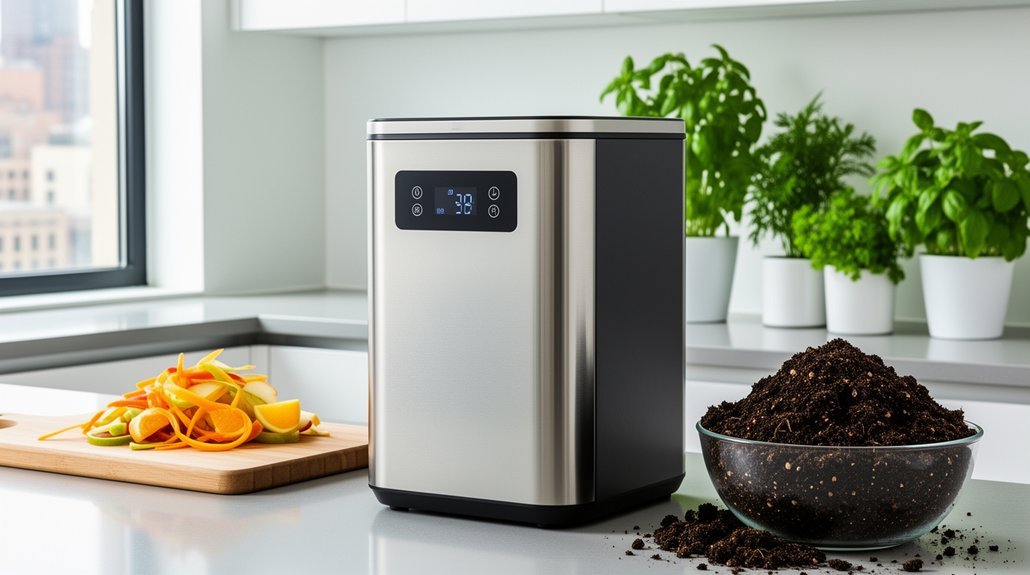
You’ll find that electric countertop composters transform your kitchen waste management by drastically cutting processing time from months to a single day, which means you’re disposing of scraps faster and controlling odors before they accumulate in your home.
The sealed design and quick cycles integrate seamlessly into your daily routine, eliminating the need for frequent trips to outdoor bins and making composting practical for apartments and small kitchens. Most models combine heat, grinding, and enzymes to accelerate decomposition through mechanical and thermal breakdown rather than relying on traditional microbial processes.
To get the best results, you’ll want to focus on soft food scraps like vegetable peels, coffee grounds, and cooked foods while avoiding items like bones and oils that don’t process as efficiently. For nutrient-rich finished compost, consider pairing your electric composter with compost tea bags to maximize the value of your processed materials.
How Speed Transforms Waste Reduction
How do electric countertop composters squeeze the decomposition timeline from months down to days? They combine heat, mixing, and forced air to accelerate the process—but here’s what you need to know about the tradeoff.
Speed delivers practical benefits for urban living:
- Rapid volume reduction – You’ll shrink food waste by roughly 90%, eliminating the need for extended indoor storage in compact apartments.
- Continuous daily processing – Many models accept small loads while running, matching your kitchen’s natural waste generation without overflow buildup. The Niasa composter, for example, handles up to 3 lbs of food waste per day while maintaining decomposition efficiency. Most electric composters use dual carbon filters to manage odors during this frequent processing cycle.
- Faster turnaround cycles – Depending on your machine, you’ll complete batches in 3 to 48 hours, making countertop composting genuinely feasible without outdoor space.
The trade-off? Your output is technically pre-compost or dried residue, not fully stabilized compost. You’ll mix it into outdoor piles or soil at dilution ratios like 1:10 to achieve finished results.
Odor Control and Kitchen Integration
The speed advantage of electric countertop composters comes with a practical requirement: managing odors in your kitchen environment. Activated carbon filters work as your first defense, with dual-layer systems capturing lingering smells during processing. Sealed lids contain odors while heat and grinding reduce food scraps, and many models include deodorize modes for stubborn smells.
You’ll appreciate the compact design—most units fit directly on countertops with 2.5 to 5-liter capacities. Touch controls and quiet operation around 40–45 dB integrate seamlessly into busy kitchens. Self-cleaning functions and dishwasher-safe bins simplify maintenance, while filter-replacement reminders keep performance consistent. Regular cleaning prevents residue buildup that can amplify odors. Most electric composters operate between 200–500 watts, making them energy-efficient additions to your kitchen. The VEVOR Kitchen Composter exemplifies how smart countertop appliances convert food waste into natural fertilizer with single-button operation. For apartment dwellers and small households, this combination transforms waste management into an odorless, space-efficient routine.
Best Food Scraps for Processing
What makes certain food scraps ideal for electric countertop composters?
You’ll achieve the fastest results by feeding your unit materials that break down efficiently. Here’s what works best:
- Vegetable peels and soft produce – Carrot peels, apple cores, and spoiling greens process quickly since they’re naturally tender and moisture-rich.
- Dry additions – Coffee grounds, eggshells, and stale bread move through cycles smoothly because lower moisture content supports faster drying and grinding.
- Pre-chopped scraps – Small, chopped pieces process evenly, reducing clumping and ensuring consistent crumb-like output within your unit’s 24 to 48-hour window.
Avoid wet foods, large bones, oily residues, and fibrous waste unless chopped fine. Don’t overload your chamber—proper air circulation matters. Your finished material works best as a soil amendment for houseplants or garden beds rather than standalone fertilizer. Like bokashi fermentation systems, electric countertop composters can process all food waste including meat and dairy when properly managed. The consistency of bread crumbs produced by electric countertop composters makes it an ideal additive to any soil.
Tumbling Composters for Balconies: Speed Up Decomposition
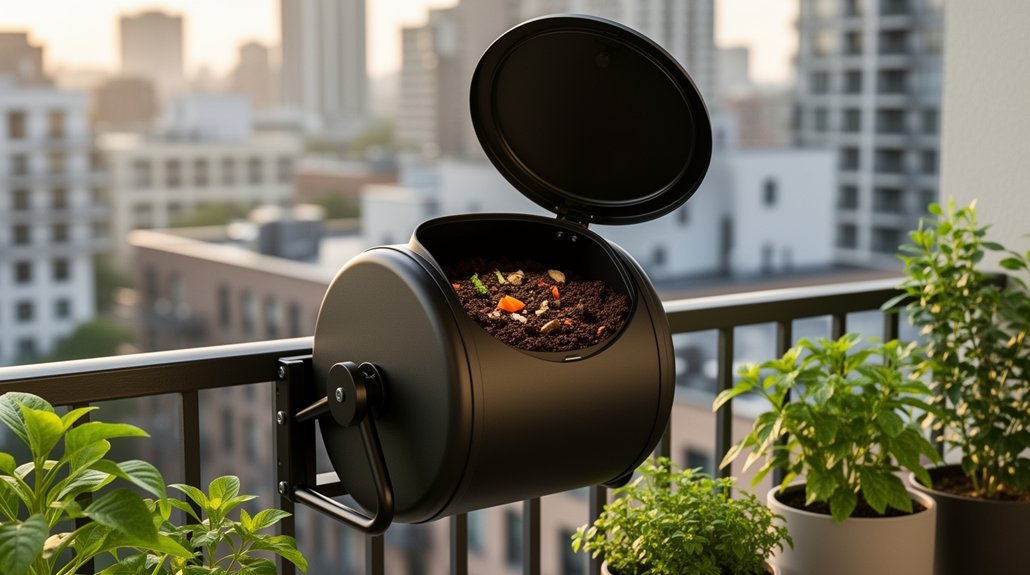
Ready to transform your kitchen scraps into finished compost in weeks rather than months? Tumbling composters speed decomposition by making aeration effortless—simply rotate the barrel every few days to redistribute oxygen and moisture throughout your mix.
You’ll see faster results by chopping food scraps into smaller pieces and balancing wet kitchen waste with dry browns like cardboard, leaves, or sawdust. Maintain a carbon-to-nitrogen ratio that keeps material moist but not waterlogged, as excess moisture creates odor and sludge. Models like the FCMP Outdoor feature multiple aeration holes and a two-chamber design that enhances the composting process even further. For smaller urban spaces, continuous-flow bag designs offer an alternative approach to faster decomposition without requiring regular manual rotation.
Position drain openings correctly during spinning to avoid leaks onto your balcony. Place a drip tray underneath to catch liquid compost tea. With proper moisture control and regular rotation, you’ll have finished compost ready for your urban garden sooner than you’d expect.
Vertical Worm Bins: Stack Composting in Compact Spaces
Within a vertical worm bin, you’ll stack trays to turn limited floor space into a thriving composting system. As you add fresh bedding and scraps to upper trays, worms naturally migrate upward toward the new food source. Meanwhile, lower trays gradually transform into finished castings ready for harvest.
Here’s what makes vertical bins ideal for apartments and small spaces:
- Space-saving design – Stackable trays maximize composting capacity without requiring large floor space
- Effortless harvesting – Remove finished castings from the bottom panel without disturbing your worm population
- Moisture management – Built-in drainage systems prevent waterlogging and anaerobic conditions
A 4-square-foot bin typically holds about 4 pounds of worms and processes 3–4 pounds of household waste daily once established. The 900D Oxford fabric with polyurethane coating ensures moisture resistance while maintaining the aerobic environment needed for healthy decomposition. Start with gradual feeding—just a cup or two weekly—until decomposition kicks in. To maintain optimal conditions and prevent overcrowding, implement a tray rotation schedule every 1-2 weeks to ensure access to fresh organic matter and support stable worm populations.
How to Choose Your Composting Method
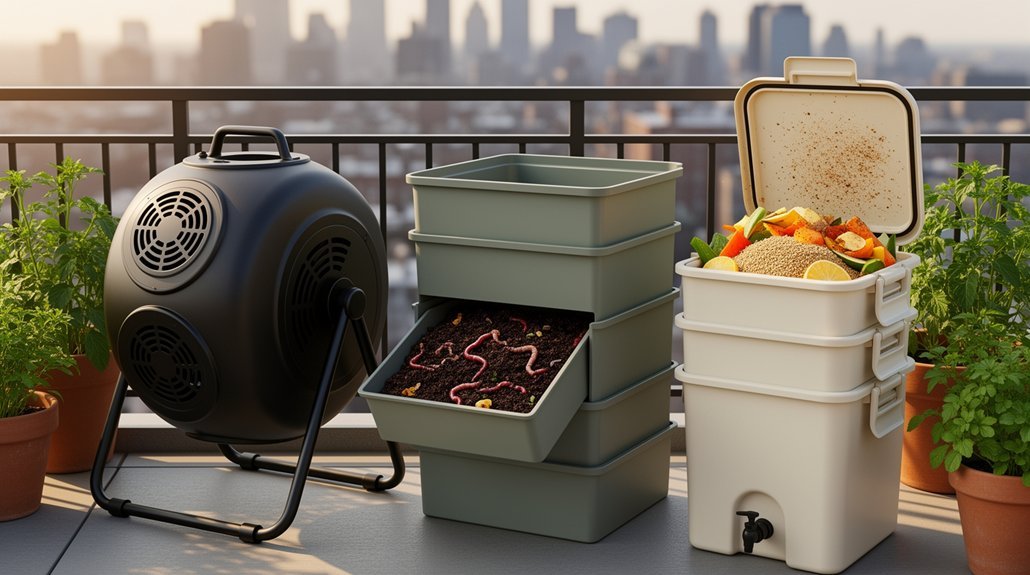
Choosing the right composting method depends on three core factors: how much space you’ve got, what scraps you’re willing to process, and how quickly you need finished compost.
If you’re tight on space, vermicomposting or Bokashi won’t take up much room. Vermicomposting costs less but requires careful feeding, while Bokashi accepts meat and dairy—perfect if you generate diverse food waste.
Need speed? Electric composters deliver finished material in 24 to 48 hours, though they’re pricier. Want low cost and minimal electricity? Vermicomposting runs around $40 to $150.
Prioritize odor control in apartments by choosing sealed systems like Bokashi or electric models. Both keep smells minimal without compromising convenience. Before your scraps reach any composting method, consider using a Clear Drop Organics Collector as your first step to prevent organic waste from going to the trash with structured, odor-free collection. Match your method to your lifestyle, and you’ll compost successfully year-round.
Community Composting: An Alternative When Space Runs Out
Even if you’ve found the perfect compact composting method, you might still hit a wall: your apartment simply doesn’t have room for a bin, or you’re not ready to manage scraps on your own.
Even if you’ve found the perfect composting method, space constraints or management concerns might require a different approach.
Community composting offers a practical solution. You’ll divert your food scraps from landfills while building connections with neighbors who share your sustainability goals. By participating in community programs, you contribute to reducing methane emissions that would otherwise be produced in anaerobic landfill conditions.
Here’s what you can explore:
- Drop-off sites at farmers’ markets, community gardens, or schools where you deliver scraps weekly
- Curbside collection programs that pick up bins from your building or doorstep on a schedule
- Cooperative services run by nonprofits that handle outreach, collection, and composting together
These programs work especially well in dense urban neighborhoods where individual composting isn’t feasible. You’ll still reduce methane emissions and support local soil health without managing the process yourself.
Frequently Asked Questions
Can I Use Composting Output From My Apartment to Grow Food Indoors Year-Round?
Yes, you can use your apartment compost to grow food indoors year-round, but you’ll need to blend it with coco coir or perlite, ensure mature compost quality, and provide adequate grow lights for consistent productivity.
What Are the Startup Costs and Long-Term Expenses for Each Composting Method?
You’ll spend $0–$10 for DIY bins, $100–$1,000 for aerated systems, and $3,500–$10,000 for multi-bay setups. Long-term costs include replacements, maintenance, electricity, labor, and equipment monitoring depending on your chosen method’s complexity.
How Do I Dispose of Compost if I Don’t Have a Garden or Yard?
You can donate finished compost to community gardens, schools, or local parks. You’ll also find neighborhood composting hubs, farmers markets, and environmental organizations that gratefully accept your finished compost for shared green spaces.
Which Composting Methods Are Safest Around Children and Pets in Small Spaces?
You’ll find enclosed bins and tumblers safest for kids and pets. Choose lidded containers with tight-fitting lids, keep them away from play areas, and avoid adding meat or dairy to reduce pest attraction and odors.
Can I Switch Between Different Composting Methods or Combine Multiple Systems Together?
You can absolutely switch methods or combine systems. You might use bokashi indoors, then finish compost outdoors, or pair vermiculture with pre-composting for flexibility that matches your space and waste volume.
In Summary
You’ve got plenty of options for composting in your urban home. Whether you’re drawn to worms, bokashi bins, or electric composters, you’ll find a method that fits your space and lifestyle. Start with what works best for your apartment or balcony, then adjust as you learn what you prefer. You’re reducing waste and creating nutrient-rich soil—that’s a win.