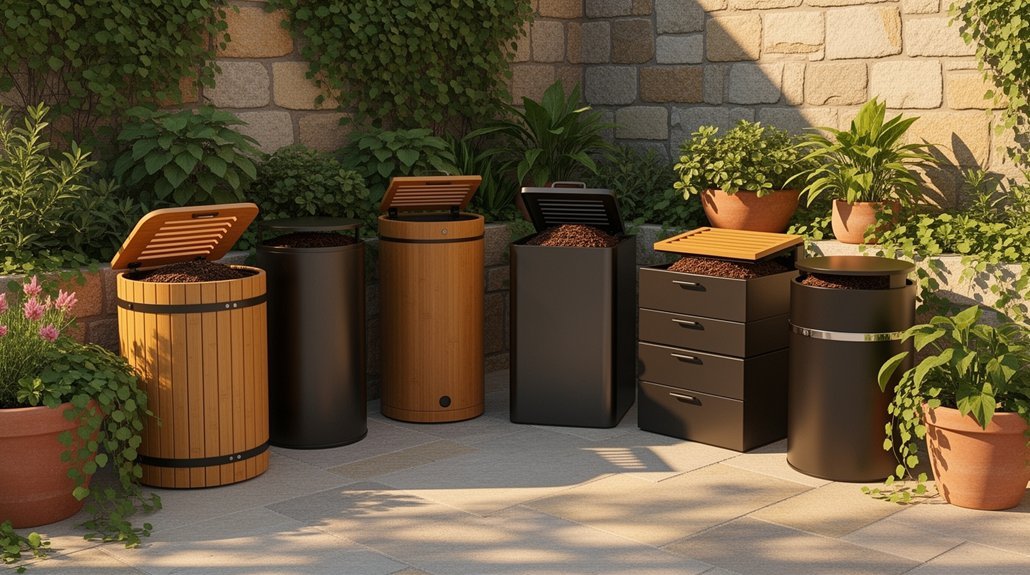

You’ll save yourself years of back-breaking maintenance and foul-smelling failures by switching from a traditional garden bin to window ledge composting. Window ledge systems deliver finished compost in weeks instead of months, require virtually no turning or layering, and seal odors away from your kitchen. They fit apartments, handle year-round composting, and keep pests out entirely. While traditional bins excel with bulk yard waste, window ledge composting offers apartment dwellers a genuinely better path forward—discover exactly how it works.
Apartment or Yard: Choose Based on Space, Effort, and Output

Where you compost matters as much as how you compost. If you’re living in a 400 sq ft studio, window ledge composting uses existing vertical space without demanding yard access or outdoor clearance. You’ll skip the turning, layering, and moisture management that traditional garden bins require, since compact indoor systems demand minimal effort and expertise.
Garden bins suit properties with yards and communal outdoor areas where you can finish compost on-site. But apartments need odor-controlled, space-efficient methods. Electric composters deliver usable output in 24–48 hours, supporting frequent kitchen-scrap diversion when storage is tight. Vermicomposting takes 2–4 months but stays low-odor when balanced properly. Bokashi handles diverse food scraps in two weeks with only a mild smell. Indoor composting methods work anywhere, with municipal options varying by location, so you can select the system that aligns with your local waste management landscape. For apartment gardeners, integrating homemade compost with potting soil at a 1:3 ratio creates a sustainable growing medium that supports herb cultivation without additional chemical fertilizers.
Your choice depends on available space, maintenance tolerance, and output speed expectations.
Window Ledge Composting: Compost Steps From Your Kitchen
How do you actually start composting on a window ledge? You’ll begin by collecting kitchen scraps in a small indoor container, then transferring them to your ledge setup in manageable portions. Chop scraps into smaller pieces to accelerate decomposition and improve airflow. To prevent odors and pest problems, avoid composting meat, dairy products, or pet manure on your window ledge, as these materials can attract insects and create unpleasant smells in your indoor space.
| Step | Action | Purpose |
|---|---|---|
| 1 | Layer dry browns as base | Create carbon foundation |
| 2 | Add chopped food scraps | Introduce nitrogen source |
| 3 | Cover with more browns | Reduce odors and flies |
| 4 | Mix periodically | Maintain aeration |
Alternate greens and browns while maintaining moisture like a wrung-out sponge. Avoid meat, dairy, and pet manure. Turn your compost regularly with a small tool to keep materials loose and well-aerated. Using a composting reference guide on or near your window space helps identify which kitchen materials are suitable for your ledge system. This hands-on approach accelerates your window ledge system toward finished compost faster than passive methods.
Sealed Systems Beat Open Bins for Odor and Pests

You’ll appreciate how sealed systems prevent odors from escaping your kitchen, especially when you add carbon filters that trap stubborn smells at the source.
Your window ledge composter’s enclosed design keeps rodents and flies out while keeping decomposition contained, which open garden bins simply can’t match.
This animal-proof barrier means you’re composting without the mess or unwanted visitors that plague traditional setups. However, closed bins require careful moisture management to prevent excessive moisture from creating anaerobic conditions and odors that defeat their containment benefits. Most compact indoor composters feature dual activated charcoal filters that maintain odor control throughout the processing cycle.
Enclosed Storage Prevents Odors
Why do sealed composting systems outperform open garden bins when it comes to controlling smell? Enclosed storage captures volatile odor compounds before they escape into your surrounding air, while open bins let decomposition odors disperse freely.
Here’s what sealed systems accomplish:
- Contain volatile compounds – Closed composting systems trap odor-causing gases from active decomposition
- Reduce smell dispersion – Enclosed facilities capture exhaust air before discharge, minimizing neighborhood impact
- Prevent anaerobic conditions – Sealed systems risk oxygen depletion, but controlled ventilation maintains aerobic decomposition, which produces far fewer foul odors
- Limit trapped moisture – Proper airflow prevents heat and moisture buildup, two conditions directly linked to odor generation
Window ledge composting takes advantage of these principles. You’ll notice significantly less smell compared to traditional open bins, especially when handling wet, nitrogen-rich kitchen scraps that would otherwise generate hydrogen sulfide and other malodorous gases. Nitrogen-focused fertilizers can also be incorporated into composting material to accelerate decomposition rates. For additional odor reduction, enzyme-based products can be applied to decomposing material to break down odor-causing molecules at their source.
Carbon Filters Contain Smells
While sealed systems control odor through ventilation, activated carbon filters provide an additional layer of defense by actively trapping the gases that escape during decomposition. You’ll find that activated carbon adsorbs ammonia and sulfur compounds rather than masking them, addressing the root cause of unpleasant smells. Pairing carbon filters with browns absorbs moisture and improves airflow to minimize odors more effectively than filtration alone. For optimal organization of your composting materials, consider using airtight food storage containers to keep brown materials dry and accessible near your composting station.
| Feature | Benefit | Application |
|---|---|---|
| 5–10 cm carbon layer | Optimal odor adsorption | Window ledge bins |
| 4 mm granular size | Balanced airflow | Indoor composting |
| 0.1–0.3 m/s velocity | Enhanced contact time | Sealed containers |
| Monthly replacement | Sustained effectiveness | Countertop systems |
| Hydrophobic membranes | Moisture protection | Long-term storage |
Your countertop compost bin stays acceptable for several days before emptying, eliminating kitchen odor buildup. You’ll replace filters every few months, maintaining odor control without the mess of traditional garden bins.
Animal-Proof Design Stops Pests
How do sealed composters keep raccoons and rodents out where open bins fail? Window ledge composters use enclosed designs that eliminate access points traditional garden bins can’t protect. Here’s what makes them superior:
- Tight-fitting lids and recessed fasteners prevent animals from prying or tearing into the structure
- Elevated, enclosed construction keeps waste elevated and contained, reducing ground-level scavenging opportunities
- Reduced odor exposure means fewer smells spread to attract wildlife in the first place
- Heavy-duty materials withstand animal interest better than lightweight plastic bins
Sealed systems keep food scraps buried under layers and contained within one physical barrier. Window ledge composters also incorporate organic nitrogen content through granule-based composting materials that accelerate decomposition while maintaining pest protection. You’ll stop scattered waste around your yard while maintaining the decomposition conditions that make composting effective. Open bins simply can’t match this protection level. Window ledge composters also work well indoors for apartments and townhouses where pest-proof designs eliminate concerns about rodents accessing your waste.
Compost More Food Without Worrying About Odors or Pests

One of the biggest concerns that keeps people from composting is the fear of attracting pests or dealing with foul smells, but you don’t have to tolerate either when you understand what causes them. Odors and pests thrive in anaerobic conditions—when moisture and heat trap oxygen from your pile. You’ll eliminate both problems by maintaining proper aeration and moisture levels around 50-55%.
Keep your carbon-to-nitrogen ratio at least 25:1, and ensure 40% free air space using bulking agents like wood chips. For optimal bedding structure, consider incorporating coconut coir, which expands into a porous, spongy composition that maintains consistent moisture levels while preventing compaction. Mesophilic microbes in the early phase help stabilize pH and enhance VOC reduction before thermophilic activity accelerates decomposition. Window ledge composting’s enclosed design acts as a biofilter, reducing odorous compounds by up to 90% compared to open piles. Faster decomposition also shrinks the window when food scraps attract unwanted visitors, letting you compost more without compromising your space.
Set It and Nearly Forget It: Minimal Daily Upkeep
You’ll find that window ledge composting demands far less turning than traditional garden bins—skip the twice-monthly mixing altogether and let passive decomposition do the work.
Unlike outdoor piles that require constant layering adjustments and monitoring, your indoor system simply sits undisturbed while microorganisms break down materials at their own pace.
This hands-off approach means you can maintain an active compost operation without the labor-intensive upkeep that typically comes with yard-based composting. Even with minimal intervention, you can still add biodegradable kitchen scraps like fruit peels, vegetable trimmings, and coffee grounds to your window ledge bin without worrying about the regular turning schedules required outdoors. Bokashi bran can absorb excess liquid and minimize odors in your compact indoor setup, making the process even more manageable.
Less Turning And Layering
Traditional garden composting demands regular maintenance—turning piles weekly in summer, monitoring moisture levels, and carefully layering browns and greens to maintain balance. Window ledge composting eliminates these burdens entirely.
You’ll skip the constant turning cycles that garden bins require. Instead, you’ll work with smaller volumes that need only occasional, lighter handling. Your layering becomes straightforward too—simply follow the EPA’s basic 2-to-3 browns-to-greens ratio without rebuilding elaborate stacked piles.
Here’s what you gain:
- Reduced aeration needs through natural air circulation in compact systems
- Simple batch-by-batch additions without major pile restructuring
- Easier moisture and odor monitoring in smaller volumes
- Temperature-based turning optional rather than mandatory
- Built-in thermometers on many window ledge models enable you to track heat generation without guesswork
You’re not abandoning composting principles—you’re streamlining them. Window ledge composting delivers decomposition results without the weekly fork work. However, maintaining adequate oxygen levels remains critical for preventing anaerobic conditions and supporting beneficial microorganisms, even in smaller systems.
Passive Decomposition Without Monitoring
What if you could compost without checking on it daily? Window ledge composting delivers exactly that. You’ll add kitchen scraps and yard waste whenever you generate them—no strict schedule required. Natural microbial activity handles the breakdown while you live your life. Unlike active systems demanding frequent temperature checks and turning, passive decomposition works quietly in the background. Earthworms and other decomposers contribute naturally, breaking down organic matter at their own pace. You’ll only need occasional moisture checks to ensure conditions stay damp enough for microbial activity. Keeping a consistent top layer of browns will help control any odors and deter unwanted wildlife from investigating your composting setup. For additional odor management, consider using activated charcoal filters designed specifically for compost bins to minimize food and organic chemical smells. This “set it and nearly forget it” approach means you spend minimal time managing your pile. The tradeoff? Decomposition takes 8–12 months or longer, but the convenience makes it worthwhile for most composters.
Why Traditional Bins Still Excel at Yard Waste

While window ledge composting excels for kitchen scraps and small-scale operations, traditional bins handle the sheer volume of yard waste that most households generate. You’ll find that larger composting systems process bulky materials far more efficiently than compact ledge setups.
Traditional bins outperform in key areas:
- Heat retention and airflow: Bins sized 3′ x 3′ x 3′ to 5′ x 5′ x 5′ maintain optimal temperatures for faster decomposition of leaves and trimmings
- Bulk material processing: You can layer carbon-rich yard waste in volume, accelerating breakdown through proper mass and aeration
- Municipal compatibility: Your local green cart programs accept bundled branches and yard trimmings designed for curbside collection
- Pest and odor control: Enclosed bins contain debris while reducing animal access and weather scatter
For landscape debris, traditional bins align with your community’s infrastructure and regulatory requirements. Models like the FCMP IM4000 with dual chambers enable continuous composting while maintaining the capacity needed for substantial household waste output.
Window Ledge Composting Year-Round: No Seasonal Gaps
How do you keep composting when snow blocks your yard bin and winter temperatures halt decomposition? Window ledge composting eliminates seasonal interruptions that plague traditional outdoor systems. You’ll maintain consistent waste diversion year-round instead of stockpiling scraps during freezing months or wet seasons.
Indoor composting sidesteps the slowdowns that reduce decomposition rates outdoors. While backyard bins dormant in winter, your indoor setup processes food scraps continuously. This steady operation diverts organics from landfills every week, not just during warm months.
Since food scraps comprise over 28 percent of household waste, year-round composting creates measurable environmental impact. You’ll reduce methane-producing landfill disposal that spikes when seasonal pauses increase trash volume. Indoor systems transform a winter liability into constant waste reduction, regardless of outdoor conditions. Backyard composting programs demonstrate that consistent waste diversion significantly reduces the need for municipal landfill capacity and collection services.
From Scraps to Nutrients: What You’ll Actually Get

Window ledge composting doesn’t just solve the seasonal problem—it transforms what you’ve been throwing away into something genuinely useful. Your kitchen scraps become nutrient-rich finished compost that feeds your plants naturally.
Window ledge composting transforms kitchen scraps into nutrient-rich compost that feeds your plants naturally while reducing waste.
Here’s what you’ll actually get:
- Slow-release nutrients that support consistent plant growth over time
- Improved soil structure that makes clay looser and helps sandy soil retain water
- Better drought resilience by increasing your soil’s water-holding capacity
- Reduced chemical dependency as healthier soil means fewer fertilizers and pesticides needed
This isn’t theoretical. You’re creating a soil amendment that enriches your root zone while keeping organic waste out of landfills. Window ledge composting lets you capture real environmental and gardening benefits from scraps you’d otherwise discard. Through composting programs like Newport’s free curbside food scraps collection, residents can participate in waste diversion initiatives that transform household scraps into finished compost for their communities.
Which System Fits Your Home and Lifestyle?
The right composting system depends on three core factors: your living space, your household’s waste waste volume, and how much hands-on management you’re willing to do.
| Factor | Window Ledge | Traditional Bin |
|---|---|---|
| Space | Fits kitchens, sills, under sinks | Requires dedicated yard or garden area |
| Waste Volume | Small households, light output | Larger households with yard waste |
| Maintenance | Simple, frequent emptying | Regular turning, layering, moisture monitoring |
If you’re in an apartment or small home without outdoor space, window ledge composting works year-round in any climate. You’ll handle regular scrap collection conveniently near food prep. For larger households with established gardens and yard waste, traditional bins manage higher volumes better. They’re suited for leaves, grass clippings, and bulky materials that indoor systems can’t accommodate. The nutrient-rich end product from both systems supports soil improvement and plant growth, though timelines and processing methods differ. Choose based on your actual space and commitment level.
Frequently Asked Questions
Can Window Ledge Composting Systems Be Used in Offices or Workplaces Outside the Home?
Yes, you can use window ledge composting systems in offices and workplaces. You’ll need management buy-in, clear waste separation rules, regular monitoring, and systems matched to your expected waste volume for success.
How Does Window Ledge Composting Compare in Cost to Purchasing Traditional Garden Composting Bins?
You’ll spend considerably less upfront on window ledge composting since you’re using repurposed containers instead of purchasing dedicated bins. You’ll also avoid ongoing maintenance costs and potential subscription pickup fees that traditional garden bins don’t eliminate.
What Specific Types of Kitchen Scraps Should Never Go Into Window Ledge Composting Systems?
You shouldn’t add meat, fish, bones, dairy, oils, cooked foods, or pet waste to your window ledge composter. You’ll also want to avoid diseased plants, weeds with seeds, and chemically treated materials.
How Quickly Does Window Ledge Composting Produce Usable Compost Compared to Traditional Bins?
You’ll get usable compost in 1-2 months with window ledge systems, while traditional garden bins typically need 6-8 months. You’re looking at roughly four to six times faster results with indoor composting.
Are Window Ledge Composting Systems Suitable for Households With Pets or Small Children?
You can use window ledge composting safely with pets or children if you limit it to plant-based kitchen scraps only. You’ll need a separate pet-waste system to prevent pathogen contamination and keep your family healthy.
In Summary
You’ll find that window ledge composting suits your busy lifestyle better than traditional bins. You’re getting nutrient-rich compost without the mess, odor, or pests that plague yard systems. You’ll maintain your setup with minimal effort while composting year-round. Whether you’ve got an apartment or yard, you’re choosing a method that matches your space and commitment level. Start small on your ledge today.