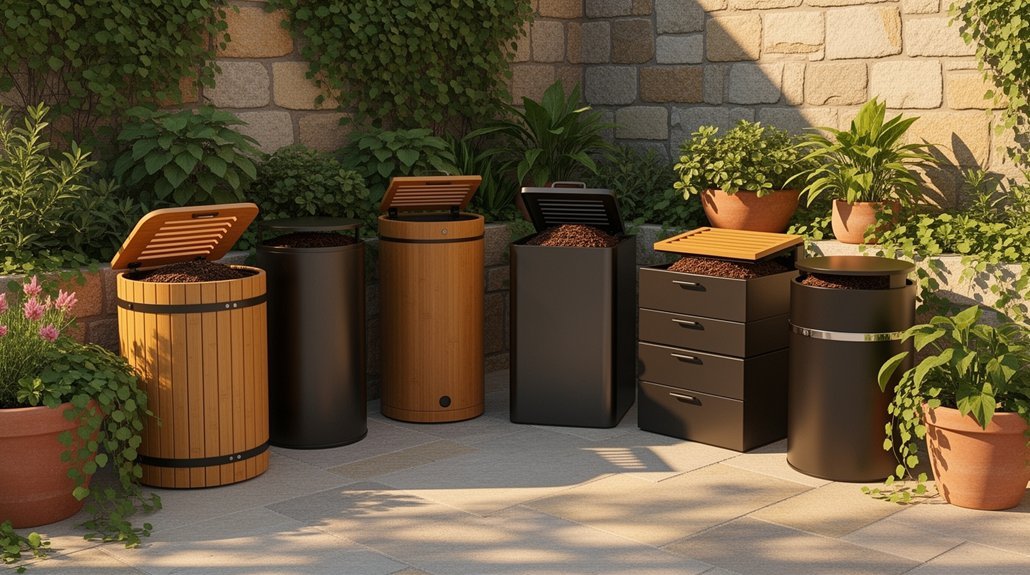

You can compost discreetly in your apartment using sealed electric units that process scraps in hours, odorless worm bins tucked under sinks, or bokashi buckets that ferment meat and dairy indoors. Each system traps odors completely and occupies minimal space—no larger than a toaster or coffee maker. Freezer storage and collection services offer zero-equipment alternatives. All options keep your composting habit invisible to neighbors while transforming waste into garden gold, and there’s a specific solution perfectly matched to your space and lifestyle.
Why Your Neighbors Won’t Notice Your Compost Bin

Sealed systems are your first line of defense. Airtight containers—whether tumblers, bokashi buckets, or electric composters—trap odors that might otherwise drift into hallways or shared kitchens. You’ll eliminate the most obvious sign of composting: smell.
Visual discretion matters too. Under-sink bins and cabinet-based systems hide waste completely. Electric composters occupy minimal counter space and resemble ordinary appliances. Freezer storage keeps scraps frozen and out of sight until you’re ready to process them. Proper bin setup in convenient, dry spots like pantries or closets further ensures your composting operation remains undetectable to those around you. Ergonomic non-slip handles on bins make them easy to manipulate in tight spaces without drawing attention.
Pest prevention reinforces your cover. Tight-fitting lids prevent fruit flies and insects that neighbors might notice. When your system stays sealed, dry, and contained, you avoid the telltale signs—odors, pests, and visible waste—that would expose your composting habit.
Vermicomposting: Hidden Worm Bins for Small Spaces
You’ll want to start by choosing an opaque bin with proper drainage and ventilation holes, then fill it with moistened bedding and red wigglers to begin your setup.
You’ll maintain low odor by adding scraps gradually, keeping bedding at a damp-sponge texture, and balancing carbon-rich materials with kitchen waste. Maintaining a well-balanced carbon-to-nitrogen ratio supports both moisture control and microbial activity in your bin.
You’ll harvest finished castings every few months by separating them from active worms, giving you nutrient-rich soil amendment for your houseplants or balcony garden. These worm castings contain significantly higher concentrations of nitrogen, phosphorus, and potassium than store-bought compost, making them exceptionally valuable for promoting plant growth in compact living spaces.
Setting Up Your Worm Bin
Where’s the best place to hide a thriving worm bin in your apartment? Start by selecting a compact, opaque plastic bin with ventilation and drainage holes. Position it on blocks or bricks to improve airflow underneath, then place a catch tray below to collect worm tea.
Layer your bin with shredded, moistened newspaper as your base bedding. Add dried leaves for carbon, then sprinkle a small handful of dirt to aid digestion. Keep bedding moist but not soggy. Properly managed indoor worm bins should produce no odors and keep worms contained inside the bin, making them ideal for discreet apartment living.
For placement, consider your pantry, under-cabinet space, or closet—anywhere cool, dark, and out of sight. If you’ve got room, a stackable tray system maximizes vertical space while minimizing your footprint. Consider using recyclable kraft paper storage boxes to organize additional composting materials near your worm bin setup. These discreet setups let you compost quietly without compromising your living space.
Maintaining Low Odor Levels
Why do some worm bins smell while others remain fresh and earthy? The difference lies in your maintenance routine. You’ll prevent odors by keeping food scraps buried beneath bedding and feeding in small portions. Excess moisture triggers anaerobic conditions that create sour smells, so you should mix dry materials like shredded cardboard or coco coir after each feeding. Regular inspection catches overfeeding and compaction before they develop problems. You can freeze scraps to reduce immediate smell and slow decomposition. Gentle aeration of the top layer prevents compacted zones. Avoid problematic inputs like meat, dairy, and oily foods. For precise control over moisture and airflow, consider using adjustable nozzle spray bottles to mist your bedding materials and maintain optimal humidity levels without oversaturation. Consistent routine maintenance matters more than bin size—stay disciplined, and your hidden system remains discreet and odor-free. For apartment dwellers concerned about landlord restrictions, worm bins are considered nearly odor-neutral options when properly managed, making them ideal for rental spaces.
Harvesting Nutrient-Rich Castings
Once your worm bin matures, the real payoff arrives: nutrient-dense castings that’ll transform your apartment plants.
With stackable tray systems, you’ll harvest easily as worms naturally migrate upward through perforated holes toward fresh bedding and food scraps. The lower sections gradually fill with finished, dark, crumbly castings while active composting continues above.
When your upper tray becomes full, simply add another perforated bucket on top with moist bedding. Once most worms have moved up, remove the lower layer—you’re left with pure, nutrient-rich castings. You can harvest in sections rather than all at once, keeping your bin productive year-round. For optimal results, employ the stop-feeding method by pausing feeding 1–2 weeks before harvest to encourage worm migration for easier collection. These worm castings are a free, nutrient-rich compost output that naturally conditions soil and boosts plant health without additional fertilizer costs.
This finished compost conditions soil and boosts nutrients for your houseplants, closing the loop on your apartment’s organic waste stream.
Bokashi Buckets: Fermenting Meat and Dairy Indoors
If you’ve dismissed composting because you can’t process meat and dairy in traditional systems, bokashi buckets offer a discreet alternative that works in apartments. This anaerobic fermentation system uses inoculated bran containing beneficial microorganisms to break down food waste in a sealed, airtight bucket.
You’ll layer scraps with bran, compact everything to remove air pockets, and wait one to two weeks for fermentation to complete. The bokashi system works best when combined with worm farming or traditional composting for final waste processing.
Unlike conventional composting, bokashi accepts meat, fish, bones, and cooked foods alongside produce and coffee grounds. The sealed design virtually eliminates odors and pest problems, making it ideal for apartments where activated charcoal filters in compost bins may not be necessary.
After fermentation, you’ll bury the material in garden soil or add it to a compost pile, where it finishes decomposing in two to six weeks, ultimately enriching your soil. The leachate liquid by-product drains from the tap and can be used as a cleaning agent or diluted for garden application.
Electric Composters: Fast Processing Without Odor

You’ll find that electric composters cut processing time from weeks to hours, which directly minimizes the bacterial growth and fermentation that typically generates odor in traditional systems.
Their compact, countertop design fits easily into studio or one-bedroom layouts, though you’ll need to weigh the electricity consumption—roughly 1 kWh per cycle—against the convenience of never hauling scraps outside. Most countertop models range from 10.5 cups to 14 liters in capacity, scaling appropriately to household cooking frequency. Target noise levels under 45 dB ensure whisper-quiet operation won’t disturb neighbors in adjacent units.
Regular filter maintenance and proper loading habits keep operating costs reasonable while ensuring your unit performs effectively and your apartment stays fresh.
How Speed Reduces Odor
Why do electric composters eliminate odors so effectively? Speed is your secret weapon. Traditional composting takes 4+ weeks, giving scraps plenty of time to decompose and release odors. Electric composters compress this process into 3 to 24 hours—some models finish in just 2 to 3 hours—drastically shortening the window when smells can build.
The machines achieve this through high-temperature drying and grinding. Drying removes moisture, which fuels odor formation. Grinding breaks down particles, accelerating processing and creating a stable, drier output less likely to smell. Models like the Smart Electric Countertop Composter transform food scraps into natural fertilizer while achieving 90% waste reduction through their high-temperature process.
This rapid conversion means you’re not leaving decomposing scraps sitting in your kitchen bin for weeks. You reduce odor exposure significantly, which matters in apartments where daily waste accumulation becomes noticeable quickly. Faster processing directly translates to fresher indoor air. Models like the Vitamix FoodCycler FC-50 feature refillable carbon filtration that further enhances odor control during the drying cycle, making them particularly effective in compact apartment spaces.
Countertop Space Efficiency
Beyond speed and odor suppression, electric composters solve another critical apartment challenge: they don’t demand much real estate. You’ll appreciate how these compact units fit seamlessly into tight kitchens without consuming valuable countertop space or requiring outdoor storage.
Here’s what makes them efficient for apartment living:
- Vertical footprint – Most models occupy minimal counter area, similar to a toaster or coffee maker
- Centralized placement – You keep food-scrap handling in one spot, eliminating the need for separate bins elsewhere
- No yard requirements – Unlike traditional composting, you’re not dependent on balcony, patio, or storage room access
- Replaces standard containers – The unit can substitute for your typical scrap holder, reducing visible waste buildup
You’ll reclaim kitchen functionality while managing composting discreetly. Electric composters produce usable compost soil in weeks rather than months, making them ideal for apartments where space constraints limit traditional outdoor tumbler options. The Pursonic FPR613’s 3-liter capacity makes it particularly suited for apartments where every inch of counter space matters, allowing you to process food waste efficiently without the bulk of larger outdoor systems.
Maintenance and Operating Costs
Before committing to an electric composter, factor in the full financial picture—upfront investment plus ongoing expenses. You’ll spend $300 to $1,000+ initially, making purchase price your largest financial barrier. Operating costs remain relatively low—expect around 50 cents to $1.66 per cycle depending on your model’s energy consumption. Additional electrical costs are estimated at approximately 5 kWh per month, which is minimal compared to other household appliances.
However, you shouldn’t overlook recurring expenses like carbon filter replacements, which typically cost $30 and need changing every 3–6 months. For optimal odor control, consider that odor-neutralizing sprays can supplement your electric composter’s built-in odor management system. Regular maintenance is essential; you’ll need to clean removable buckets frequently and harvest compost regularly to prevent clogs and odors. While some higher-end models offer dishwasher-safe components and automated cleaning programs, conventional composting remains cheaper overall if you’ve got outdoor space available.
Under-Sink Storage: The Invisible Composting Solution

How can you keep composting completely hidden in a small apartment? You’ll find that under-sink storage transforms your compost operation into an invisible system.
Here’s why this approach works:
- Space efficiency – You’re utilizing wasted cabinet space, keeping compost gear out of sight and off your countertops entirely.
- Odor control – Sealed bins with carbon filters trap smells before they escape, while liquid separation reduces dampness that causes unpleasant odors.
- Discretion – Compact caddies fit standard cabinet dimensions, and stainless steel options resist discoloration and bacterial buildup.
- Low maintenance – Larger-capacity models hold 2–4 weeks of scraps, reducing how often you’ll need to handle contents.
Under-sink composting keeps organic waste contained and your kitchen looking pristine. The self-cleaning design means you won’t spend time maintaining the system, allowing the separator to handle solids automatically while liquids flow down the drain.
Compost Collection Services: Zero In-Unit Equipment
If you’re searching for composting that requires zero equipment inside your apartment, collection services eliminate the need for bins, tumblers, or electric appliances altogether. You’ll simply gather food scraps in a countertop or freezer container until pickup day arrives. Many providers supply compostable liners or branded pails, though basic kitchen containers work fine too. Your scraps leave your unit before decomposition begins, which keeps odors and pests completely out of your space.
Collection schedules range from weekly to multiple times per week depending on your provider and location. Municipal haulers, private subscription services, and app-based community networks all offer different access points. You’ll need to check coverage in your ZIP code since availability depends on local regulations and regional composting infrastructure. Finished compost can be used for indoor plants or shared in community gardens once your scraps reach the composting facility.
Balcony Tumblers: Space-Saving Outdoor Composting

When you need composting that stays off your kitchen counter yet remains completely contained, balcony tumblers offer a discreet outdoor alternative that fits apartment living. These compact units transform organic waste into finished compost while maintaining a tidy appearance.
You’ll benefit from several key advantages:
- Sealed designs prevent pest access and odor escape better than open bins
- Rotation mechanisms accelerate decomposition through improved aeration and mixing
- Elevated stands enhance drainage while minimizing direct balcony contact
- Dual-chamber models let you cure finished material while adding fresh scraps simultaneously
Choose single-chamber tumblers for space constraints or dual-bin designs for higher volume processing. Tested models in the 18.5 to 65-gallon range demonstrate that compact sizes remain easy to turn even when partially loaded. Ensure your building permits outdoor composting and respects weight limits. With proper browns-to-greens balance and regular turning, you’ll produce quality compost discreetly.
Active vs. Passive Indoor Composting: Which System for You?
What separates a fast-finishing compost system from a low-maintenance one? The answer lies in your effort level and timeline expectations.
Active indoor composting requires you to frequently turn, mix, and aerate materials, generating heat that kills pathogens and seeds. You’ll see finished compost in 4–8 weeks but need consistent monitoring of moisture, oxygen, and temperature.
Active composting kills pathogens through heat while delivering finished material in 4–8 weeks, requiring consistent moisture and oxygen monitoring.
Passive systems demand minimal intervention—you add materials and wait 6–12 months for natural decomposition. They’re simpler and more discreet for apartments, though they won’t reliably sanitize feedstock or reach high temperatures. This process works by creating favorable conditions for decomposers like bacteria and fungi that break down organic matter naturally.
For apartments, passive systems work best when you prioritize low maintenance and containment. Choose active composting only if speed and pathogen reduction outweigh convenience. Either way, sealed containers control odors and keep your space discreet.
Getting Started: Installation, Maintenance, and Cost

Now that you’ve chosen between active and passive systems, it’s time to turn your decision into action. Here’s what you’ll face as you set up your apartment composting system:
- Installation: Worm bins fit under sinks or in closets; bokashi needs an airtight bucket; electric composters require a nearby outlet; balcony tumblers need rotation space.
- Maintenance: Worm bins demand regular feeding and moisture control; bokashi requires bran additions and 10–14 day fermentation cycles; electric units automate most work. Remember that microorganisms decompose materials in a ventilated, moisture-controlled environment to generate the heat necessary for efficient processing.
- Costs: DIY worm bins cost minimal money, while bokashi involves recurring bran purchases, and electric composters represent your highest investment.
- Discretion: All systems control odor and mess effectively—vermicomposting stays odorless, bokashi ferments sealed, and electric units process enclosed.
Frequently Asked Questions
Can I Compost in an Apartment if I Have Pets or Allergies to Worms?
You can absolutely compost in your apartment with pets or worm allergies. Bokashi bins and electric composters offer sealed, odor-controlled alternatives that keep pets away from scraps and eliminate worm exposure entirely.
What Should I Do if My Composting System Starts Smelling Despite Following Instructions?
You should first check your moisture levels and airflow—add dry browns if it’s too wet. Then adjust what you’re composting, inspect seals and placement, and consider a full system cleaning if odors persist.
How Long Does It Take to Produce Usable Compost From Each Method?
You’ll get usable compost in 2–6 months with vermicomposting, 4–8 weeks with Bokashi, hours to a day with electric composters, and 2–6 months with outdoor tumblers. Electric composters are fastest.
Are There Any Lease Restrictions or Landlord Permission Issues to Consider First?
Yes, you must review your lease for storage, balcony, and sanitation restrictions. You’ll want written landlord permission for any system—especially outdoor equipment. Request approval by documenting odor control and pest prevention measures.
Which Composting Method Produces the Most Finished Compost for Indoor Apartment Use?
You’ll produce the most finished compost indoors using vermicomposting. Red wiggler worm bins convert food scraps into usable compost and nutrient-rich castings within 3–6 months in a compact footprint.
In Summary
You’ve got plenty of options to compost discreetly in your apartment. Whether you choose vermicomposting, bokashi buckets, electric composters, or collection services, you’ll reduce waste without bothering your neighbors. Start small with what fits your space and lifestyle. You’ll find that apartment composting isn’t just environmentally responsible—it’s entirely manageable when you pick the right solution for your home.