
You’ll stop soggy, smelly compost by giving it constant, deep airflow. Use a 3‑ft‑diameter wire bin with side vents and a perforated base so fresh air sweeps through the pile, keeping it in the 40‑60 °C thermophilic range. Add coarse browns like straw, wood chips, or shredded paper to create air pockets, and turn or aerate the pile every few days to prevent compacted zones. Keep moisture around 50‑60 % by testing a deep handful and adjusting with dry material. If you keep these steps, you’ll discover even more tricks to keep your compost dry and fast.
Why Airflow Is the Key to Dry, Fast Compost

oxygen fuels aerobic microbes, which decompose organic matter far more efficiently than their anaerobic counterparts. When fresh air circulates, microbes stay active, generate heat, and keep the pile in the thermophilic range of 40–60 °C, accelerating breakdown. Airflow also evaporates excess moisture, preventing soggy, compacted zones that choke oxygen. Coarse bulking materials—straw, wood chips, twigs—create pores that let air and water move freely, maintaining the ideal 50–60 % moisture level. Turning, drilling holes, or using passive pipes injects fresh oxygen and loosens packed material, shortening the active composting phase to roughly three weeks. Countertop compost bins with airtight lids help contain odors while you prepare materials for your main pile. In short, proper aeration drives speed, heat, and quality. Proper aeration also prevents compaction, ensuring uniform oxygen distribution throughout the pile.
How to Spot Soggy, Anaerobic Compost Early
You’ll notice a mushy, slime‑covered texture and a sour, pickled odor as soon as oxygen runs low. If the core stops warming or even cools while the outer layers stay warm, the pile’s heating is off‑balance. Waterlogged, compacted spots that feel heavy and soggy are the tell‑tale signs of anaerobic trouble. Add dry browns in generous handfuls between layers to restore proper aeration. A tight-fitting lid can trap excess moisture and create anaerobic conditions if moisture drains are blocked or absent.
Mushy Texture and Odor
Ever wondered why your compost feels more like mud than soil? You’re probably seeing a dense, matted texture and a sour, rotten‑egg smell—classic signs of excess moisture and oxygen loss. When grass clippings and unshredded leaves stick together, air pockets disappear, and the pile turns slimy and heavy. The surface may look compacted while deeper layers stay wet, trapping leachate and fostering anaerobic bacteria. You’ll notice a musty or ammonia‑like odor that intensifies after rain or when you skip turning. Unlike traditional composting methods, bokashi systems maintain odor control through sealed, airtight conditions that prevent the anaerobic problems plaguing open piles. Spotting these cues early lets you add dry browns, aerate, and keep the pile airy. Turn regularly to introduce oxygen and break up matting.
| Sign | What you see | What it means |
|---|---|---|
| Texture | Dense, mud‑like, slimy | Air spaces gone |
| Smell | Rotten‑egg, sour, ammonia | Anaerobic activity |
| Surface | Compacted, dark zones | Trapped moisture |
| Bottom | Pooling liquid, leachate | Over‑saturation |
Heat Build‑Up in Core
When the mud‑like texture and sour smell give way to a hot spot in the middle of your pile, that heat is a warning sign of oxygen loss. A rapidly warming core indicates aerobic microbes are working hard, but if the temperature spikes past 140 °F and stays there, oxygen is likely being depleted. You’ll feel a dense, heavy mass that resists turning, and the outer shell will stay cooler while the center stays scorching.
Uneven heating, a stalled temperature rise, or a sudden plateau after adding fresh material all point to airflow failure. Keep moisture between 50‑65 % and turn before the core exceeds 140 °F. This restores pore space, supplies oxygen, and prevents the anaerobic shift that makes compost soggy. Thermophilic activity dominates once the pile’s temperature rises above 113 °F. Consider using airtight storage containers for finished compost to maintain optimal moisture retention and prevent degradation of your final product.
Waterlogged Layers and Compaction
How can you tell your compost is turning soggy before it ruins the whole pile? Dark, glossy patches and surface crusts hint at excess moisture, especially where kitchen scraps or fresh grass clippings gather.
Standing water at the base or slumped layers show poor drainage and displaced air spaces. Feel for slimy, sticky material and dense mats that have compacted into heavy masses—these textures block airflow.
A heavy, compressed pile feels far from fluffy, and fine‑textured inputs settle tightly, sealing pore spaces. Similar to how paper shredders require regular maintenance to prevent jams and maintain performance, compost piles need consistent attention to prevent compaction and preserve beneficial microbial activity.
Sour, vinegar‑like odors or rotten‑egg smells signal anaerobic fermentation, while ammonia hints at nitrogen overload.
If the compost feels beyond the “wrung‑out sponge” level and squeezes out liquid, you’re approaching saturation. Add dry browns, turn the pile, and improve drainage to restore aeration before the problem spreads. Regular watering is vital to maintain beneficial microbes and prevent excess moisture.
Choosing the Right Bin Design for Dry‑Compost Ventilation
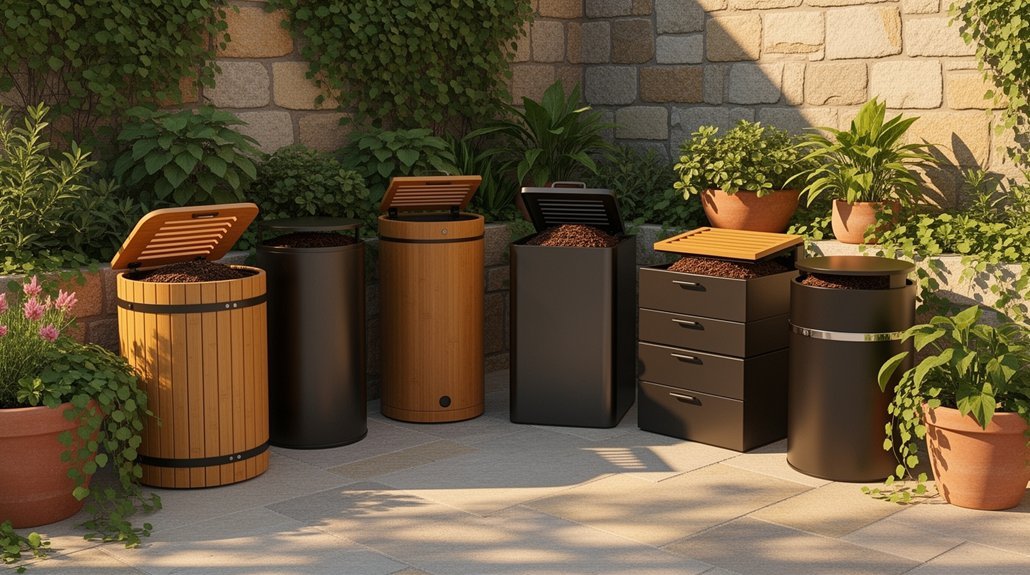
You’ll find that open‑sided wire bins let air sweep through the whole pile, while ventilated base channels pull fresh oxygen up from the bottom. Adding adjustable side vents lets you fine‑tune airflow to match your climate and moisture levels. These features together keep the compost dry, aerobic, and fast‑acting. The three‑bay design with removable face boards donkey‑proof ensures easy access and optimal ventilation. Organic alfalfa meal and other nitrogen-rich materials can be layered strategically to maintain proper carbon-to-nitrogen ratios while supporting aerobic decomposition.
Open‑Sided Wire Bins
Why settle for a soggy pile when a well‑ventilated wire bin can keep your compost dry? Choose a cylindrical design—3 ft diameter by 4 ft tall works for most gardens, and you can scale up with 10–13 ft of 1″ × 2″ welded wire for larger volumes.
Use hardware cloth or welded wire for rigidity; coated or galvanized mesh resists corrosion, while PVC‑covered cloth can trap moisture. For fermentation systems requiring similar moisture management principles, glass fermentation weights help maintain proper liquid levels in contained environments.
If you use lighter fencing, add stakes, rebar, or wooden posts around the perimeter for stability, but remember stakes make moving the bin harder.
The open sides let oxygen flow from every direction, preventing anaerobic odors and soggy pockets.
Tie the top with twist ties or wire loops for quick dismantling and relocation.
Quick setup allows a bin to be assembled in about ten minutes.
Ventilated Base Channels
A well‑ventilated wire bin keeps the sides dry, but the real battle against soggy compost starts at the bottom, where a base‑channel system channels fresh air directly under the pile. You’ll want a layout that keeps pipe runs short, so pressure loss is minimal and the blower can push air through dense layers. Space the channels so every point in the pile stays within about 18 inches of an opening, and protect those openings with fabric or screening to stop plug‑ins. Use capped pipes with drilled holes along the top to spread air evenly, and choose a bin size around 3 ft³ for natural flow. Tools like aerator tools can help break up compacted zones that restrict airflow in deeper sections of your compost pile.
- Short pipe runs preserve pressure and airflow strength.
- Evenly spaced outlets prevent dead zones and wet spots.
- Perforated or capped pipe ends spread air instead of a single exit.
- Landscape fabric or window screen protects intake from clogging.
- Bin dimensions (≈3 ft³) keep airflow efficient in deeper piles. Keyer clips insert sideways, twist to 90 degrees.
Adjustable Side Vents
Ever wondered how to keep your compost dry without sacrificing airflow? Adjustable side vents let you fine‑tune oxygen and humidity. In cold or dry weather you can close the vents a bit to hold heat; when the pile gets soggy, open them wider to flush excess moisture. Choose a bin with slatted cedar or drilled‑plastic sides so you can slide panels or twist screws to the desired opening.
Wider slots accelerate drying but may over‑aerate in hot winds, while narrow slots preserve warmth while still preventing anaerobic pockets. Tall, narrow bins channel air differently than wide ones, so match vent size to your bin’s shape. For indoor bins with limited ventilation, charcoal filters can work alongside proper airflow design to manage odors effectively. With adjustable side vents you balance odor control, pest protection, and easy turning for a consistently dry, active compost. The community’s experience with a relocated, rebuilt bin shows that proper ventilation can prevent rotting even in older compost setups.
Adding Side Vents or Drilled Channels to Boost Dry‑Compost Airflow
Ever notice how a soggy compost pile seems to stall? Adding side vents or drilled channels lets fresh air rush in and humid air escape, keeping the pile aerobic and odor‑free. Cut rows of holes or attach perforated panels at upper and mid‑wall levels to create cross‑flow. Balance hole size and spacing so you get enough oxygen without over‑drying. Protect openings from rain and clear any clogged shreds regularly. Pair vents with occasional turning for best results. Quality bedding materials like coconut coir can also improve drainage and prevent compaction issues in your compost system.
Add side vents or drilled channels to keep compost aerobic, odor‑free, and moving efficiently.
- Drill evenly spaced holes (½‑inch) along both sides of the bin.
- Install perforated panels for continuous airflow while retaining material.
- Use PVC channels with drilled slots for internal air pathways.
- Position vents near the top to let moist air exit without losing compost.
- Check and clean vents weekly to prevent blockage from fine particles.
Regular fluffing or turning helps keep bacteria oxygenated and prevents matting/compaction aerobic conditions**.
Using a Ventilated Base or Pallet System for Under‑Pile Circulation

Side vents get fresh air into the upper layers, but the lower zones still need oxygen to stay active. A ventilated base or pallet lifts the compost off wet ground, creating a gap where air can circulate. Use a simple wooden pallet, slatted board, or perforated floor; the gaps let oxygen slip under the heap and escape through side vents. Position the pallet before you build the pile, and consider adding perforated PVC pipe or chicken‑wire ducts beneath it for extra pathways. This under‑pile airflow prevents stagnant, soggy zones, keeps moisture from pooling, and helps heat escape, maintaining a balanced temperature. By keeping the base open and elevated, you give the whole pile the oxygen it needs without extra fans. The C:N ratio must stay within 20:1‑40:1 to sustain microbial activity.
Why You Should Turn and Fluff Your Pile Regularly
You’ll boost aerobic microbes by shaking up the pile, which floods the material with fresh oxygen. Turning and fluffing stop compaction and the sour smells that come from anaerobic pockets. They also spread moisture evenly, keeping the compost moist but not soggy. Proper aeration reduces odor by preventing anaerobic conditions.
Boosts Aerobic Microbes
Usually you’ll see a thriving compost when you turn and fluff the pile regularly, because oxygen is the lifeblood of aerobic microbes that break down organic matter quickly. Turning replenishes oxygen, redistributes active colonies, and creates pore spaces that keep the matrix loose. This boosts microbial metabolism, speeds heat generation, and spreads thermophilic activity evenly. The result is a faster, more uniform breakdown without the sluggish spots that form in compacted zones.
- Replenishes interior oxygen for active microbes
- Mixes hot, rich zones with cooler material
- Spreads colonies evenly, reducing dead pockets
- Generates and distributes heat for thermophilic microbes
- Creates pore spaces that sustain airflow and rapid decomposition
- Turning helps balance moisture by mixing dry, carbon‑rich material into soggy areas.
Prevents Compaction and Odors
When the pile compresses, oxygen can’t flow, and anaerobic microbes start producing foul odors; you must turn and fluff it regularly. Turning restores pore spaces that collapse as material shrinks, letting air reach the core and keeping the heap loose.
A porous structure prevents dense zones where decomposition stalls and odors build up. By breaking up matted clumps, you expose trapped material to fresh air, releasing gases that would otherwise linger. Regular fluffing also distributes undecomposed bits from the edges inward, promoting even heating and faster breakdown. This aerobic ventilation stops the center from becoming compacted, reduces smelly, soggy pockets, and keeps the whole pile active and healthy. Turning maintains the aerobic state of the compost pile.
Balances Moisture Distribution
Compaction and odors disappear when you turn and fluff the pile, but the real benefit shows up in moisture management. You spread moisture evenly, preventing soggy pockets and dry spots that stall microbes. Fluffing opens compacted zones, boosting pore space so water drains while staying available for microbes. Mixing browns and greens absorbs excess liquid and spreads it throughout, keeping the heap from becoming waterlogged. Regular turning stops layering that creates wet bottoms and dry tops, ensuring every inch stays consistently moist. This balanced moisture speeds decomposition and yields a finer, ready‑to‑use compost.
- Redistribute wet pockets into drier sections
- Increase pore space for better drainage and retention
- Blend browns with greens to absorb surplus water
- Break up layers that block moisture movement
- Maintain a steady, microbial‑friendly moisture level
Oxygen is essential to sustain beneficial microbes and prevent anaerobic pockets that cause odors.
Hand‑Held Aerator Tools for Maintaining Dry Compost in Small Bins
Ever wonder why your small compost bin stays soggy despite regular turning? Hand‑held aerators give you vertical air channels without digging up the whole pile. A corkscrew/auger twists down, then you reverse‑rotate to pull up, opening pathways that let moisture evaporate. Folding‑wing tools insert flat, open on withdrawal, mixing and loosening dense spots. Long‑handled turners (≈36 in) reach the full depth, while drill‑attached augers speed the job in tight bins. Use several insertion points, space them evenly, and work slowly in dense zones to avoid binding.
| Tool | Length / Reach | Ideal Feature |
|---|---|---|
| Corkscrew/Auger | 12‑18 in | Narrow profile, vertical channels |
| Folding‑Wing Aerator | 12‑15 in | Opens on pull‑up, mixes material |
| 36‑in Hand Turner | 36 in | Reaches full depth of small bins |
Brown Materials That Create Structure and Airflow for Dry Compost

Need you wondering why your compost stays soggy despite regular turning? The secret lies in the brown materials you layer in. Choose coarse, woody pieces that hold shape and form air pockets, especially at the bottom. Straw and dried stalks add hollow, airy structure that resists matting, while dry leaves—particularly oak—absorb moisture and stay loose longer. Shredded paper and cardboard bulk up the pile and create voids, but keep them shredded for easy mixing. Fine browns like coarse sawdust can mop up excess liquid, but balance them with larger pieces to avoid compaction.
Coarse wood, straw, oak leaves, shredded paper, and a touch of sawdust create airy, moisture‑balanced compost.
- Wood chips, twigs, small branches
- Straw, hay, dried stalks
- Dry leaves, leaf litter (oak preferred)
- Shredded paper, cardboard, corrugated rolls
- Coarse sawdust or wood shavings (small amounts)
Balancing Greens and Browns to Keep Moisture in Check
Why does your compost turn soggy even after regular turning? Because you’ve got too many moisture‑rich greens and not enough dry browns to soak them up. Greens dump nitrogen and water, while browns act as a moisture sponge and keep the pile porous. Aim for a 2:1 or 3:1 browns‑to‑greens ratio, adjust by feel, and always mix rather than layer. Chop everything fine, then toss a handful of shredded newspaper or straw into each bucket of kitchen scraps. This spreads moisture evenly, prevents slimy pockets, and lets air flow.
| Issue | Quick Fix |
|---|---|
| Excess greens | Add 2 × browns by volume |
| Slimy texture | Mix in dry carbon (leaf litter, cardboard) |
| Anaerobic smell | Turn and aerate, then rebalance ratio |
How to Test and Adjust Moisture for Dry Compost?

Wondering how to tell if your compost is too dry and how to bring it back to life? Grab a handful from 18–24 inches deep, squeeze firmly, and watch the reaction. If it crumbles into dust, it’s below the 40‑60 % moisture sweet spot. If it holds together and drips a few drops, you’re in range. Add water slowly, mix, and repeat the squeeze until a small amount of moisture releases without flooding the pile.
Grab a deep handful, squeeze; if it crumbles, add water, mix, and repeat until it feels like a wrung‑out sponge.
- Use the hand‑squeeze test on an interior sample.
- Aim for a wrung‑out sponge feel, not a dry crumble.
- Add water incrementally while turning the pile.
- Re‑squeeze after each addition to confirm even moisture.
- Stop when a handful releases a few drops, not a stream.
Troubleshooting a Smelly, Soggy Compost Pile
If your compost feels soggy and smells like rotten eggs, the problem is usually oxygen loss. Anaerobic microbes thrive when waterlogged, compacted material blocks airflow, producing hydrogen sulfide and methane. First, turn the pile to break up dense zones and expose the core to air. Then, layer dry carbon‑rich browns—shredded leaves, straw, or cardboard—to soak up excess moisture and reopen pores. Keep the base on a permeable surface so water can drain, and avoid adding too many fresh greens at once. If the odor persists after aeration, you likely have a chronic oxygen deficiency rather than just a moisture issue.
| Symptom | Quick Fix |
|---|---|
| Rotten‑egg smell | Turn pile, add browns |
| Slimy surface | Improve drainage, reduce wet greens |
| Stagnant heat | Loosen compacted material |
| Persistent sour odor | Increase airflow, balance C:N |
| Water pooling at base | Elevate bin, use permeable base |
Frequently Asked Questions
Can I Use a Compost Tumbler for Large‑Scale Aerobic Composting?
No, you’ll struggle with large‑scale aerobic composting in a tumbler; its limited capacity, frequent filling needs, and moisture control challenges make it inefficient compared to bigger bins or open piles.
How Often Should I Add Dry Leaves to a Soggy Pile?
Add dry leaves whenever the pile feels soggy—usually after each wet addition or weekly checks. Keep adding in layers and turn the pile until it feels damp, not soaked. Adjust frequency based on rain and material input.
Do Indoor Compost Bins Need Extra Ventilation Compared to Outdoor Ones?
Yes, indoor bins need extra ventilation because they lack natural airflow; you should add more holes, use fine mesh, and stir often to keep oxygen high, moisture low, and odors under control.
What Temperature Range Indicates Proper Aerobic Activity?
You should see temperatures between 90 °F and 140 °F. That range means microbes are actively using oxygen, breaking down material efficiently, and keeping your compost healthy and aerobic.
Can I Compost Coffee Grounds Without Causing Moisture Problems?
Yes, you can compost coffee grounds without moisture issues if you mix them with coarse, dry browns, keep them under 20 % of the volume, and turn the pile regularly to maintain airflow.
In Summary
By keeping air moving through every layer, you’ll prevent soggy spots and speed up decomposition. Use a well‑ventilated bin, add side vents or drilled channels, and place the pile on a pallet for under‑pile flow. Mix plenty of browns, balance greens, and check moisture regularly. If the pile smells or stays wet, adjust ventilation and material ratios. With these steps, your compost stays dry, fast, and odor‑free.