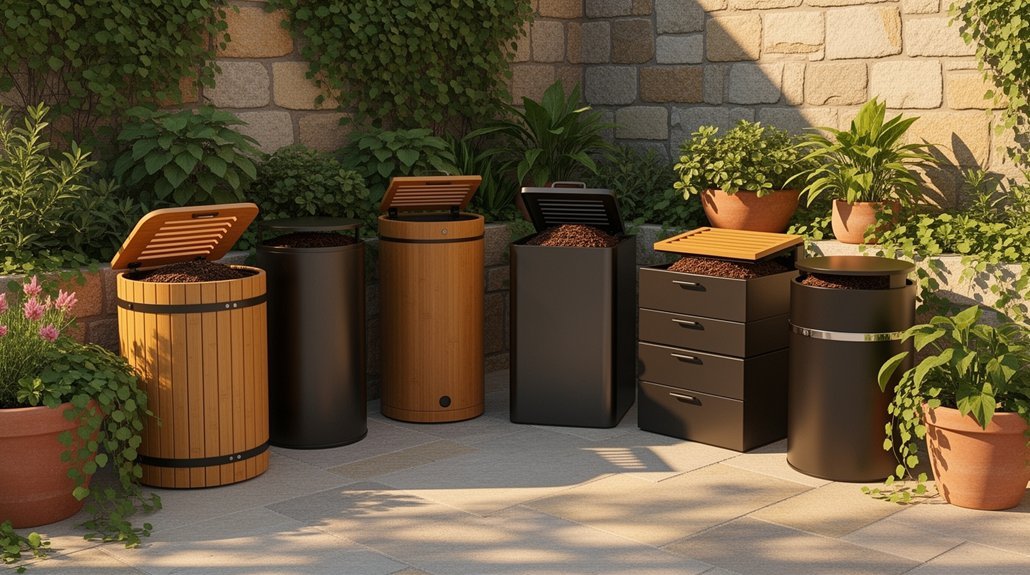

You can compost without a yard using vermicomposting bins with red wigglers, bokashi fermentation buckets for meat and dairy, or electric composters that process scraps in hours. Worm bins cost less but work slower, while electric units reduce waste by 90% quickly. You’ll also find community drop-off programs at gardens and farms. Each method offers different trade-offs between speed, cost, and space requirements—discover which suits your lifestyle best.
Find the Right Composting Method for Your Space
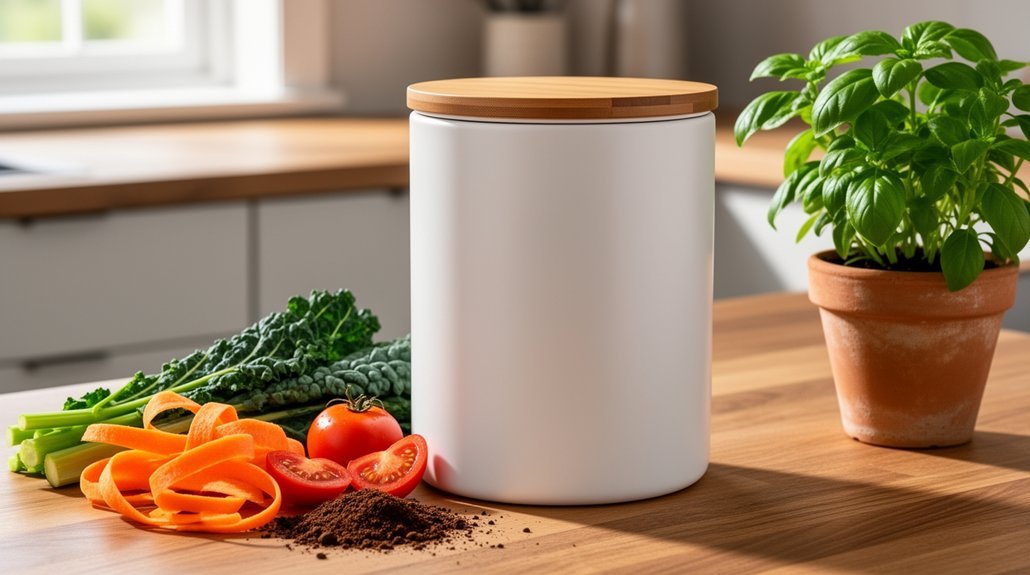
How do you choose a composting system that’ll work in your apartment or small home? Start by assessing your available space and odor tolerance. High-traffic apartments benefit from low-odor methods like bokashi or freezer storage, while compact sealed systems work well in under-sink cabinets or closets.
If you prefer minimal effort, electric composters offer speed and convenience, though they cost more upfront. Traditional aerobic bins suit balconies or patios but require regular turning and more room for carbon materials.
For the lowest maintenance option, consider community drop-off programs or pickup services—they eliminate odor, pests, and in-home processing entirely. Your choice ultimately depends on your space constraints, effort level, and whether you need finished compost for home use. Worm composting works particularly well in apartments because red wiggler worms efficiently convert food scraps into nutrient-dense castings with minimal odor. Proper waste sorting accuracy ensures that only appropriate materials enter your composting system, which prevents contamination and improves the quality of your finished compost.
Start Composting Indoors With Vermicomposting
If you’re drawn to the idea of composting but lack outdoor space, vermicomposting offers a compact, odor-free solution that works beautifully in apartments and small homes.
You’ll need a plastic storage bin around 2.2 square feet with aeration holes drilled in the lid and sides. Fill it with damp bedding—shredded newspaper, cardboard, or coconut coir work well—then add red wigglers, the standard worm species for indoor systems. The end product is vermicompost containing worm castings, decomposed bedding, and living worms that can be reused for future batches. Consider using airtight storage containers to keep your bedding materials dry and organized before adding them to your bin.
| Component | Details |
|---|---|
| Container | Plastic bin under 15 inches deep |
| Bedding | Shredded newspaper or coconut coir |
| Worm Species | Red wigglers only |
| Temperature | 60–80°F ideal range |
| Weekly Capacity | 2–3 lbs. kitchen scraps |
Bury food scraps under bedding to minimize odor and pests. Keep conditions around 60–80°F with consistent moisture—like a wrung-out sponge. Within months, you’ll harvest nutrient-rich vermicompost for houseplants and gardens.
Ferment Food Scraps Using Bokashi Buckets
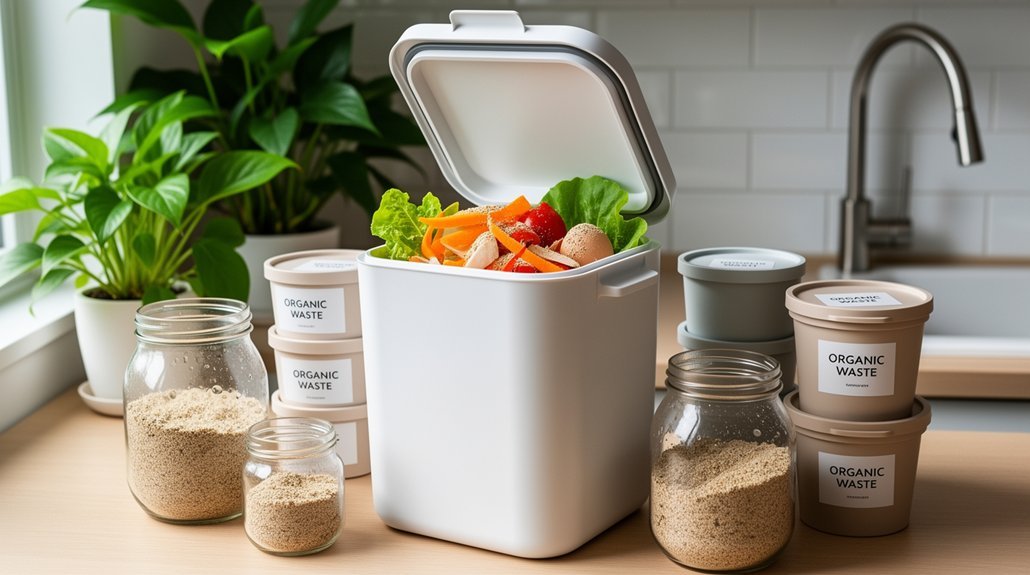
You’ll ferment your kitchen scraps in a bokashi bucket by layering food waste with inoculated bran, which creates an anaerobic environment that breaks down everything from meat to dairy to cooked foods in 10-14 days.
Once fermentation completes, you’ll bury the pickled material in garden soil or compost where it’ll finish decomposing over 2-4 weeks before you plant nearby. During this post-burial period, the pre-compost transforms into a nutrient-rich soil amendment ready to support plant growth.
This method gives you odor-free indoor composting and lets you process food scraps that traditional compost systems can’t handle. Bokashi buckets feature reinforced seams to prevent leaks when liquids accumulate during the fermentation process.
How Bokashi Fermentation Works
Want to compost indoors without odors or heat generation? Bokashi fermentation offers an elegant solution. You’ll pack food scraps tightly into a specialized airtight bucket, layering them with inoculated bran containing lactic acid bacteria and other effective microorganisms. This anaerobic process differs fundamentally from traditional composting—it preserves rather than rapidly breaks down waste.
As fermentation proceeds, lactic acid bacteria ferment available sugars, lowering pH quickly and creating acidic conditions that suppress odor-causing microbes. Within two weeks, your scraps transform into fermented material ready for soil integration or further decomposition. The resulting leachate can be diluted and used as plant food, providing additional value from your compost system. The process retains carbon that would otherwise escape as gas, while preventing pest attraction and eliminating the unpleasant smells associated with conventional composting. Unlike traditional composting methods, bokashi systems can handle meat and dairy, expanding the range of kitchen waste you can process.
What You Can Compost
Now that you understand how bokashi fermentation works, you’ll want to know what materials actually go into your bucket. Bokashi systems accept a much wider range of food waste than traditional composting methods, making them ideal for apartment dwellers.
| Accepted | Use Sparingly | Avoid |
|---|---|---|
| Fruit/vegetable scraps | Large bones | Non-organic items |
| Cooked foods | Excessive liquid | Synthetic materials |
| Meat and fish | Very moldy food | Contaminated paper |
| Dairy and eggs | Large quantities of one item | — |
| Coffee grounds, tea | Paper towels (if soiled) | — |
You can compost most kitchen scraps, including citrus, bread, rice, and pasta. Animal-based foods like cheese and yogurt work well too. Keep portions reasonable and avoid large bones or excessive moisture to maintain balance in your bucket. Most bokashi systems use charcoal filters to control odors during the fermentation process. The fermentation-based process yields a special liquid for dilution and fertilization, along with compost mass that improves garden soil quality.
From Bucket To Garden
Once your bokashi bucket’s fermentation cycle completes in about two weeks, the material inside isn’t yet finished compost—it’s a essential intermediate stage that requires one more step. You’ll need to bury or mix the fermented scraps into soil to complete decomposition. Use a garden bed, trench, or lidded finishing tote as your second-stage breakdown area. Layer soil and dry carbon materials like leaves over the fermented scraps to support microbial activity. Soil organisms and microbes then continue breaking down the material into usable compost over four to six weeks under favorable conditions. For kitchen composting without outdoor space, consider using compostable trash bags to line your finishing tote for easier cleanup and material transfer. The leachate drainage during fermentation also produces a nutrient-rich liquid that can be diluted and applied directly to plants for immediate feeding benefits. This finishing stage transforms your fermented bokashi into nutrient-rich compost ready for your plants.
Process Food Scraps Fast With Electric Composters
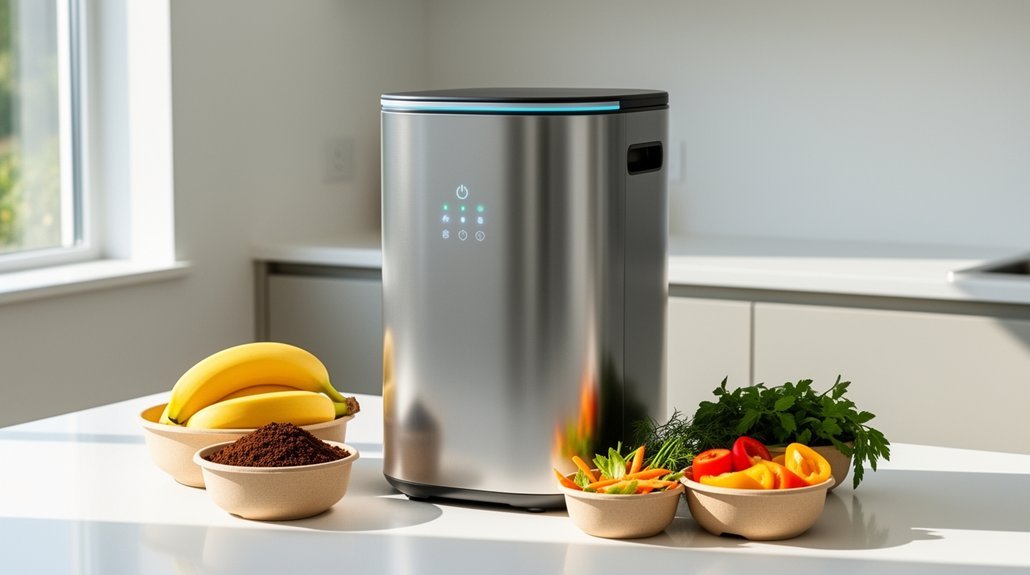
How can you transform food waste into usable material in just a few hours? Electric composters grind and dry your scraps using heat and motors, often completing cycles in three to twenty-four hours. Many units process two to three pounds daily while reducing waste volume by ninety percent.
You’ll appreciate the odor control—carbon filters and sealed chambers keep your kitchen fresh. Most models accept fruit, vegetables, coffee grounds, eggshells, and cooked food. Some handle meat, fish, and dairy too. Popular compact models like the AMZCHEF 4L composter offer 90% odor reduction with activated carbon filtration for consistent kitchen freshness.
The finished product resembles soil or bread crumbs, ready for houseplants, garden beds, or municipal compost. While drying-based models aren’t true compost, microbe-based systems produce compost-like fertilizer. Initial product costs typically range from 299 to 800 dollars, with ongoing expenses for filter replacements and energy use. Electric composters solve food-scrap management without requiring outdoor space.
Compost in Small Outdoor Spaces
What if your balcony or patio could become a composting hub? You can start with as little as 1 square foot of space using compact enclosed bins, tumblers, or DIY containers made from trash cans or drums. A 3x3x3-foot bin retains heat better, but smaller systems work well for tight areas.
Keep your compost damp like a wrung-out sponge and turn it regularly to prevent odors. Small containers dry out faster, so check moisture frequently. Mix greens and browns in a 1:1 or 2:1 ratio, chopping materials into small pieces for faster breakdown. Cover food scraps with dry material to discourage flies. Bury or partially bury containers to reduce visible bulk while improving drainage and discretion in tight neighborhoods. Using a lasagna layering approach with alternating food scraps, coffee grounds, cardboard, and shredded paper accelerates material breakdown and improves decomposition efficiency in compact systems. For optimal results, consider using bokashi fermentation for handling all types of food waste including meat and dairy in small spaces.
Use Community Composting Programs
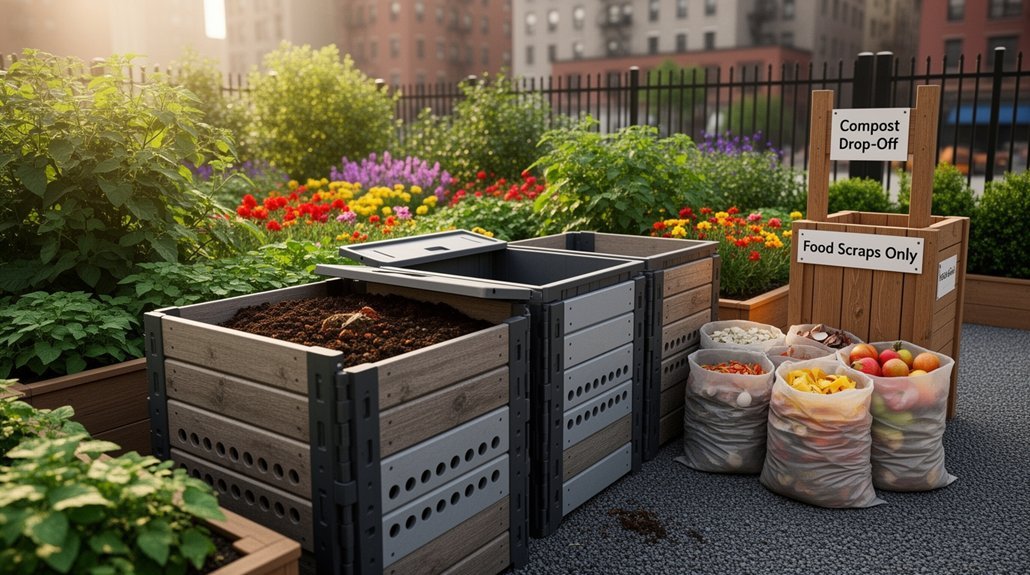
If you’re composting in a confined space, you’ve already discovered how little room you need—but there’s an even simpler option if you’d rather skip the bins altogether. Community composting programs eliminate the composting work entirely. You’ll drop off your food scraps at a local site—typically located at schools, farms, community gardens, or parks—and let volunteers handle the rest. These programs fill crucial gaps in neighborhoods lacking curbside organics collection, making composting accessible for apartment dwellers and dense urban areas. Check with your local solid waste department or extension office about available programs. In Wichita, free composters are available to community gardens through an application process. You’ll divert organics from landfills, reduce methane emissions, and support local soil health without maintaining any equipment at home.
Compare Costs, Effort, and Results
Now that you’ve explored your composting options, you’ll want to weigh the trade-offs between cost, effort, and results to find what fits your lifestyle and space. Bokashi and worm bins demand minimal hands-on work, while passive home composting requires regular turning and moisture checks.
Cost-wise, DIY home bins are cheapest, though aerated systems offer faster results at $100–$1,000 upfront. Worm bins and bokashi fall between these extremes. Most composting methods can process food scraps and yard waste simultaneously, making them versatile waste solutions. Bokashi systems in particular excel at fermenting meat, fish, and dairy alongside plant materials thanks to their specialized bokashi bran containing beneficial microorganisms.
DIY home bins are most affordable, while aerated systems cost $100–$1,000 but deliver faster results.
Home composting diverts waste for about $11–$12 per ton, making it economical long-term. If you prioritize low effort, choose bokashi or worms.
Want speed and control? Aerated systems deliver faster decomposition.
Seeking affordability? Build a simple passive bin.
Your choice depends on balancing convenience, budget, and processing speed.
Frequently Asked Questions
How Often Should I Feed My Worm Bin, and How Much Food Can I Add?
You should feed your bin every 5-7 days when new, then weekly once established. Add about 1 cup of food or 10% of your worm weight. Feed only after you’ve consumed the previous feeding.
Can I Compost Meat and Dairy in My Home Composting System?
You shouldn’t add meat and dairy to standard home compost bins because they attract pests, create odors, and decompose slowly. Instead, you’ll want to use bokashi systems or municipal composting programs designed for animal products.
What Should I Do With Finished Compost From My Indoor Bin?
You can mix your finished compost into houseplant potting soil at a 30% compost to 70% soil ratio, use it as a top dressing on indoor plants, or store it for later garden bed applications.
How Much Does It Cost to Use Municipal or Subscription Composting Services?
You’ll typically pay $32 monthly for subscription pickup services or $5–$41 per ton through municipal programs, depending on your location, waste volume, collection frequency, and local disposal fees.
Will My Composting Method Create Odors or Attract Pests Indoors?
Your indoor composting method can create odors and attract pests if you’re not careful. You’ll prevent problems by freezing scraps, using sealed bins, adding dry browns, and emptying frequently.
In Summary
You’ve got plenty of options for composting without a yard. Whether you’re vermicomposting in your apartment, fermenting scraps with bokashi, or using an electric composter, you can reduce your waste considerably. If you prefer outdoor solutions, community programs and small-space methods work great too. Pick what fits your lifestyle and budget, then get started. You’ll be amazed at how much you’re diverting from landfills.