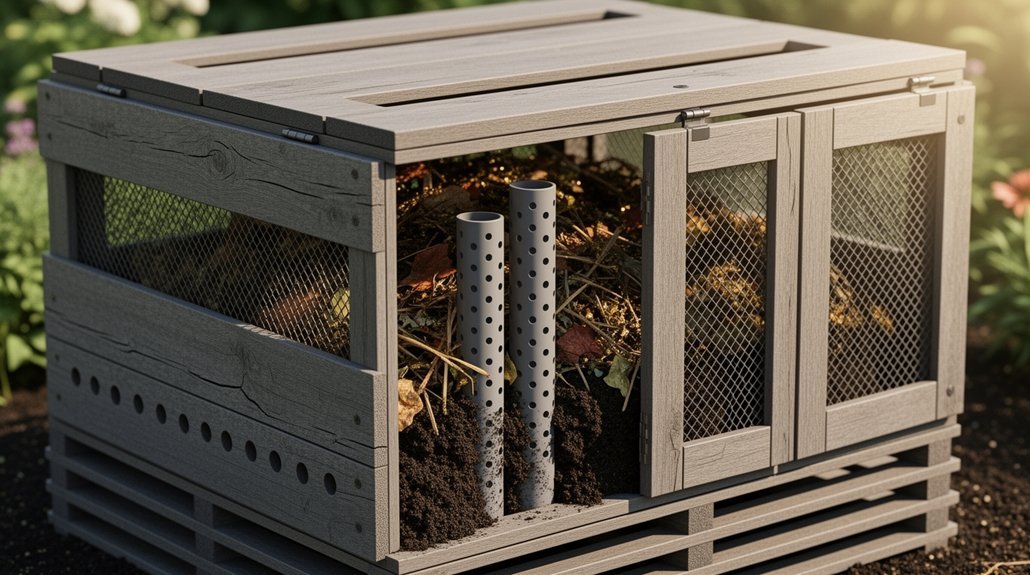
You’ll recognize poor airflow by rotten egg smells and slimy textures—signs your pile’s suffocating. Start by turning your pile every few days to inject oxygen fast. You can drill holes every 4-6 inches around bin walls or elevate your bin on a slatted base for passive airflow. For a permanent solution, install perforated PVC pipes as internal air channels. Forced-air systems work best for larger operations, cutting decomposition time dramatically. Each method tackles aeration differently, and you’re about to discover which fits your setup.
Why Airflow Matters: Recognizing and Fixing Poor Compost Circulation
Why does your compost bin smell like rotten eggs? That foul odor signals anaerobic conditions caused by insufficient oxygen. When you don’t maintain proper airflow, decomposition slows dramatically, and your pile shifts toward rotting instead of composting.
You’ll notice other warning signs too: slimy, compacted textures indicate trapped moisture and restricted gas exchange. Cold piles that decompose slowly despite balanced carbon and nitrogen levels likely suffer from oxygen starvation. Worms in undersized bins may show stress and reduced activity.
To fix these problems, break up matted materials to restore air pockets. Add coarse brown materials like sticks or stalks to improve internal porosity. Consider bin designs with side holes or low-side openings that promote natural airflow. For kitchen compost crocks specifically, charcoal filters in lids help manage odors while you work toward larger-scale aerobic composting solutions. Regular turning and ventilation are complementary strategies that work together to maintain the aerobic conditions your pile needs for efficient decomposition. These changes shift your pile back toward healthy, efficient aerobic decomposition.
The Fastest Fix: Turning and Fluffing Your Pile
How quickly can you transform a sluggish compost pile into an active decomposer? Turning and fluffing rank among the fastest fixes for poor airflow. When you turn your pile every few days—or even daily for maximum speed—you’re adding oxygen that accelerates decomposition and redistributes heat throughout. Use a digging fork to lift material efficiently, moving outer, less-decomposed layers into the hotter center while bringing interior material outward. This process breaks up compacted zones and mats that restrict microbial activity. During each turn, check moisture levels and adjust by adding water or dry browns as needed. Berkeley-style hot composting typically requires seven turnings over eighteen days, proving that frequent aeration delivers rapid results. For best results, consider using aeration holes and deep fins throughout your pile to accelerate decomposition even between manual turns. Incorporating coarse materials like semi-decomposed wood chips throughout your pile maintains structural integrity and prevents the density issues that block oxygen flow even after turning.
Passive Compost Ventilation: Holes and Air Gaps That Work
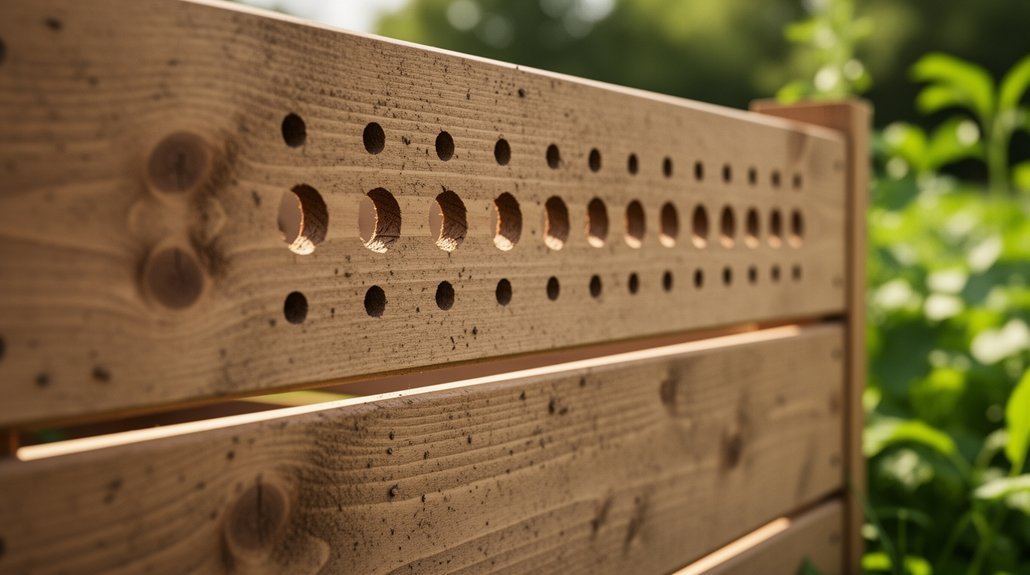
While turning your pile delivers fast results, you don’t need to fork material every few days to keep your compost breathing. Instead, you can rely on passive airflow through strategic holes and air gaps.
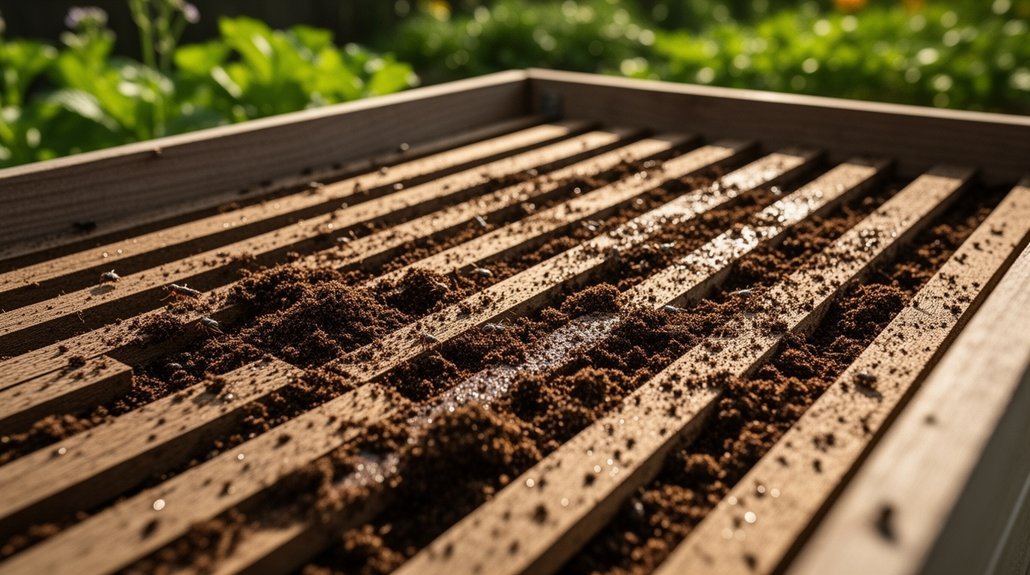
Drill holes every 4 to 6 inches along your bin walls to let decomposition gases escape and oxygen enter. Pallet-style bins naturally provide enough leakage through their gaps for practical ventilation. The key is balancing airflow with containment—too many large openings let material spill out and reduce aesthetics. Proper ventilation supports the four composting essentials: green matter, brown matter, water, and oxygen.
Base elevation matters equally. Raise your bin 3 to 6 inches on a slatted foundation to draw air from below, preventing soggy lower layers. Consider bins with adjustable air vents and deep fins designed to enhance passive airflow while maintaining structural integrity. This under-bin airflow works alongside wall openings to maintain aerobic conditions without constant intervention.
Compost Aeration With Perforated PVC Pipes
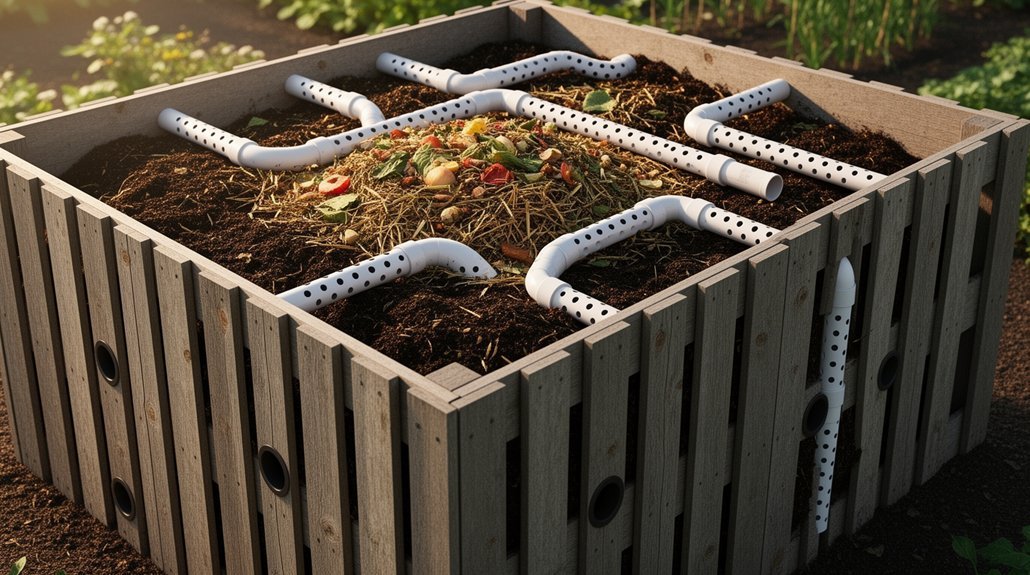
When you’re ready to move beyond surface-level ventilation, perforated PVC pipes offer a straightforward way to push oxygen deep into your compost pile. You’ll insert 1- to 2-inch PVC pipe vertically or horizontally through your bin, creating internal air channels that function like chimneys.
Before installation, drill 1/2-inch holes every 2 to 6 inches along the pipe’s length, spacing them on all sides to maximize airflow. Position pipes before or during pile construction so material forms around them. For larger systems, distribute multiple pipes evenly across the heap. A typical three-bin setup benefits from 10 perforated sections arranged in horizontal rows at different pile depths.
This passive aeration reduces your turning frequency while supporting aerobic decomposition, controlling odors, and maintaining hot composting conditions without constant manual effort. Red wigglers and other composting organisms thrive in well-aerated environments, breaking down organic matter more efficiently and producing nutrient-rich castings that enhance soil quality.
Forced-Air Aeration Systems for Larger Operations
Perforated PVC pipes work well for moderate-scale operations, but they’re limited by passive airflow—they can’t keep pace with the oxygen demands of high-volume composting. Forced-air systems solve this by using fans to actively push or pull air through your pile, delivering airflow rates roughly 100 times higher than passive methods. For operations handling substantial volumes of yard waste and kitchen scraps, implementing deep fins and aeration holes ensures maximum oxygen mixing throughout the composting process.
| Configuration | Method | Best For |
|---|---|---|
| Positive aeration | Pushes air in | Faster processing |
| Negative aeration | Pulls air through | Odor control |
| Reversing aeration | Alternates directions | Optimized efficiency |
You’ll control airflow through duty cycling, variable-frequency drives, or automated dampers. Computerized monitoring lets you match airflow to microbial demand, reducing energy waste. A well-engineered forced aeration system sustains optimal process conditions by maintaining uniform air supply and adjustable airflow for temperature control. This approach stabilizes compost in 10-15 days versus 90+ days passively, while increasing your site’s throughput significantly.
Frequently Asked Questions
How Do I Balance Airflow With Heat Retention in My Compost Bin?
You’ll balance airflow with heat retention by using low side openings, adding a perforated base, and inserting internal PVC pipes with drilled holes. This setup maintains oxygen flow while preserving your pile’s warm core temperature.
Can I Use Forced-Air Systems in Small Backyard Compost Bins Effectively?
You can use forced-air systems in small bins, but you’ll need adequate depth and bulk to retain heat. Without sufficient volume, you’ll lose moisture too quickly, and uneven airflow creates dead zones that reduce effectiveness.
What Coarse Materials Work Best for Maintaining Pore Space and Airflow?
You’ll get the best results mixing finger-sized twigs, chopped straw, and shredded cardboard throughout your pile. These materials resist collapse, create air channels, and prevent matting while you’re building your compost bin.
How Often Should I Monitor Moisture Levels to Prevent Airflow Blockage?
You’ll want to check moisture weekly during active composting, but increase to twice weekly or daily during hot, dry weather when evaporation accelerates. After heavy rain, inspect immediately to prevent waterlogging and airflow blockage.
What Happens if My Compost Pile Receives Too Much Ventilation?
Your compost pile can dry out too quickly, cool down and slow microbial activity, release odors, and develop inefficient decomposition. You’ll need to balance ventilation carefully to maintain proper moisture, temperature, and oxygen levels.
In Summary
You’ve learned how critical airflow is to your compost success. Whether you’re manually turning your pile, installing passive ventilation holes, or investing in perforated PVC pipes, you’ll dramatically speed up decomposition. For larger operations, forced-air systems offer the ultimate control. Pick the solution that fits your space and commitment level. You’ll soon have rich, finished compost that’ll transform your garden.