Pick three sturdy 4‑ft cubes and line them up: fresh scraps go in the first, partially broken material in the second, and finished humus in the third. Use cedar pickets and T‑shaped dividers for airflow, then add a porous wood‑chip base and BPI‑certified liners for drainage and easy cleaning. Keep a 30:1 carbon‑to‑nitrogen mix—about three parts browns to one part greens—turn each bay every few days, and watch the core hit 130‑160 °F for rapid breakdown. Rotate the bins regularly, lift them off the ground in winter, and you’ll keep odors and pests at bay while the compost matures in weeks. The next steps will show you how to fine‑tune temperature and moisture for even faster results.
Select Bins and Place Your Three‑Bin Compost Rotation
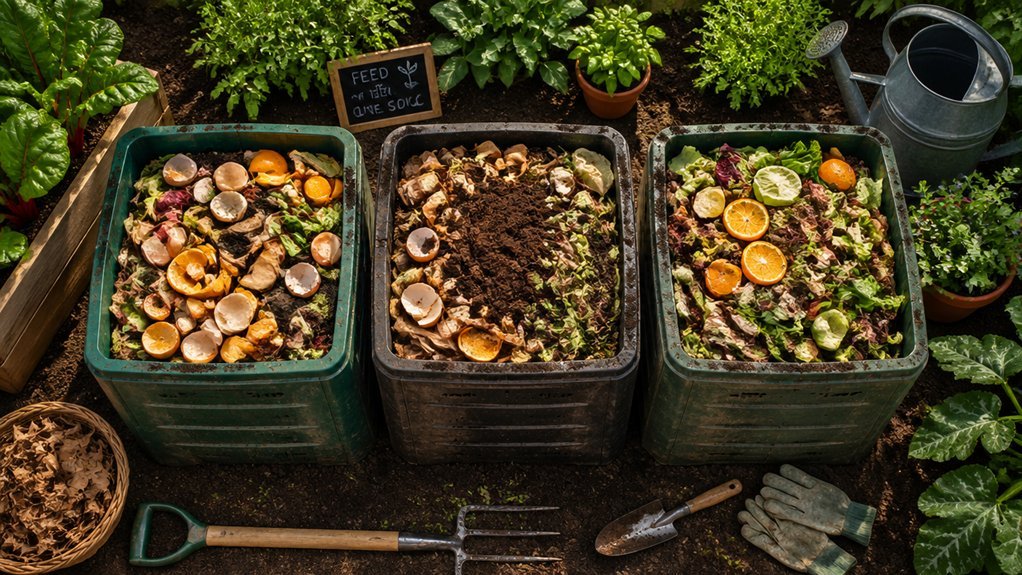
You’ll start by picking three sturdy bins—ideally 4 ft × 4 ft × 4 ft each—and arranging them in a line so the first receives fresh scraps, the second handles active composting, and the third holds finished material.
Use cedar fence pickets for the walls; they let air flow, resist rot, and keep the compost bins stable.
Insert custom T-shaped dividers to create clear separation bays, preventing cross-contamination between stages.
Insert T‑shaped dividers to define distinct bays and prevent cross‑contamination across compost stages.
Level the central block to promote even drainage and avoid waterlogging, which boosts aeration throughout the three-bin rotation.
Design the layout with wheelbarrow access in mind, adding sliding guides for easy adjustment and maintenance.
This setup streamlines loading, turning, and harvesting while maintaining optimal airflow and structural durability BPI-certified liners.
Balance Carbon/Nitrogen for a Three‑Bin Compost Rotation
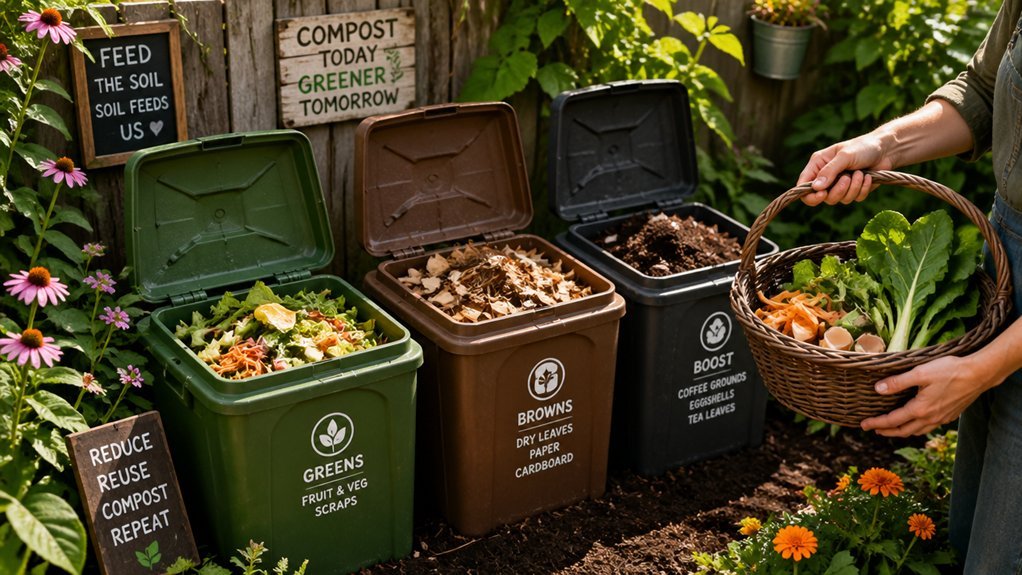
Balancing carbon and nitrogen is the secret sauce that keeps a three‑bin rotation humming. Aim for a 30:1 carbon‑to‑nitrogen ratio, mixing browns like leaves and wood chips with greens such as food scraps and grass clippings in roughly a three‑to‑one split. Proper drainage and airflow are essential to prevent soggy pockets and odor buildup, especially when using a porous base to aid aeration. Load each bin sequentially: the first receives fresh greens, the second hosts material that’s begun breaking down, and the third finishes the composting process. Keep moisture steady and turn regularly to preserve aerobic conditions, using a porous base to aid airflow. Avoid high‑fat, protein, or cooked‑starch items, and bury or divert them to prevent anaerobic pockets. Aerobic Conditions
Maintain Temperature in a Three‑Bin Compost Rotation
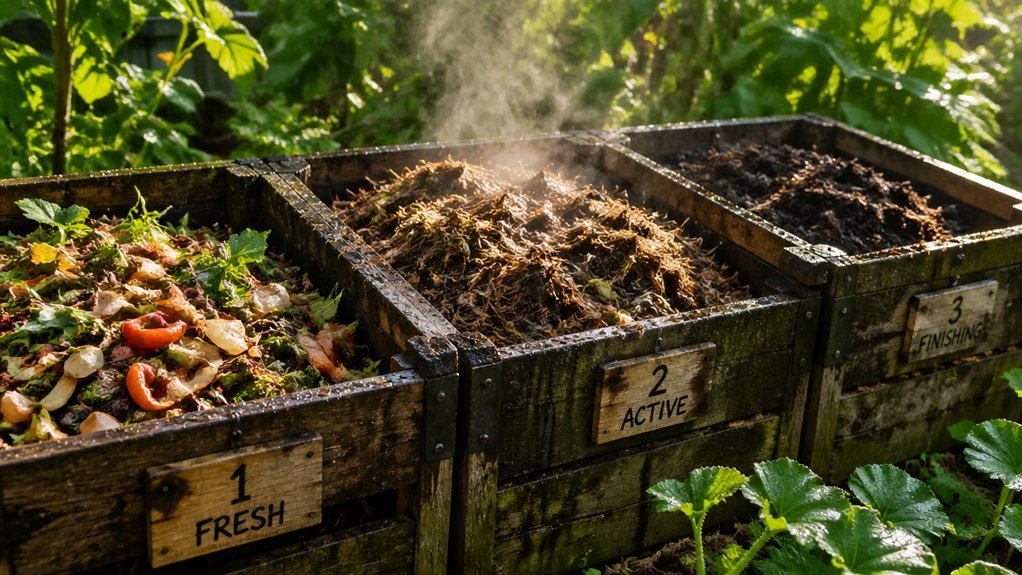
With the carbon-to-nitrogen ratio set, the next step is keeping the pile hot. Aim for a core temperature around 131°F for three days; peaks of 160°F are normal. Use a long-stem thermometer to monitor heat from the center to the edges, ensuring the interior stays hot while the outer layers cool. Regular aeration helps sustain the hot zone, and turning every few days supports continuous heat generation aeration and turning. For temperature management, turn the pile every few days to boost aeration and prevent anaerobic spots. Add a porous base like wood chips to keep airflow steady and moisture balanced—moist but not soggy. In a three-bin rotation, move finished material to the next bin, preserving an active hot zone while fresh scraps start in a clean bin. Consistent aeration and careful moisture control keep the composting process fast and effective.
Rotate Bins for Continuous Supply in a Three‑Bin System
How can you keep a steady stream of ready‑to‑use compost without waiting weeks for a single pile to finish? In a three‑bin rotation, you can also benefit from maintaining an odor‑controlled, airtight environment to prevent unwanted smells during continuous processing odor control. You do it by rotating bins in a three‑bin rotation that creates a continuous supply. Fill the first bay with fresh scraps, then move it to the middle bay where active composting and aeration occur. After a few weeks, shift that material to the third bay to finish maturing while you start a new load in the first bay. By turning each bay regularly and keeping moisture balanced, you maintain airflow and speed decomposition. This staggered flow lets you harvest nutrient‑rich compost every few weeks, eliminating idle periods and ensuring you always have material ready for the garden.
Fix Odor, Pests, and Winter Problems in a Three‑Bin Rotation
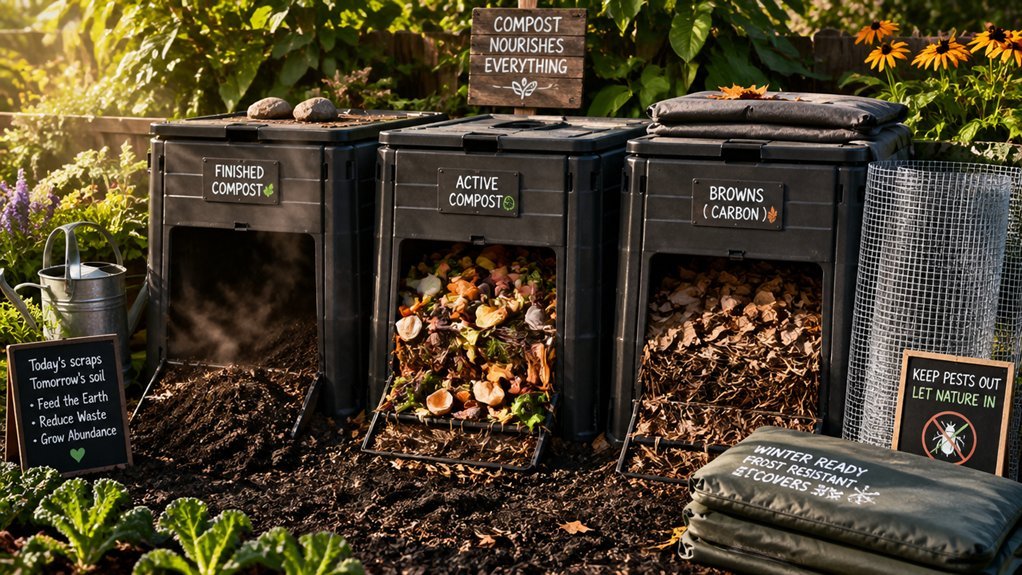
A steady compost supply is great, but without proper odor, pest, and winter management it can quickly become a hassle. In a three-bin rotation you keep fresh scraps in Bin 1, mature material in Bin 2, and finished compost in Bin 3. This separation gives you natural odor control and blocks pests. Aim for a hot pile of at least 131 °F for three days to kill pathogens and weed seeds, which also reduces smells that attract critters. In winter, lift bins off the ground, add straw or a cedar-bin cover, and keep a vented culvert for airflow. Turn regularly, monitor temperature with a long-stem thermometer, and sprinkle carbon-rich browns to stay aerated. To maintain consistent performance, you can also choose compact, odor-controlled units with auto-cleaning features that help manage smells in indoor setups odor control features.
Frequently Asked Questions
What Is the 3 Bin Method?
You use three separate bins: start fresh scraps in Bin 1, move partially decomposed material to Bin 2 for aeration, and keep finished compost in Bin 3, rotating continuously for efficient, ongoing composting.
What Three Things Should Not Be in the Compost Heap?
You shouldn’t put protein‑rich foods, dairy or meat, and anything contaminated with herbicides or cooked starches into the compost heap; they attract pests, cause odors, and slow decomposition.
Is Bokashi Composting Worth the Effort?
Yes, you’ll find Bokashi worth the effort if you crave fast, odor‑free kitchen waste breakdown in tight spaces, and you don’t mind buying bran and doing a final soil burial.
How to Manage a 3 Bin Compost System?
You keep the first bin full of fresh scraps, turn it into the second for active decomposition, then move it to the third to mature; rotate bins weekly, monitor moisture, aerate, and maintain a 30:1 carbon‑nitrogen balance.
In Summary
You’ve now got a reliable, low‑maintenance system that turns kitchen waste into garden gold. By rotating three bins, balancing carbon and nitrogen, and keeping temperature steady, you’ll harvest rich compost year‑round. Fix odors, keep pests out, and protect the pile in winter—then enjoy the boost to soil health and plant growth. Your backyard becomes a sustainable, thriving ecosystem with minimal effort.