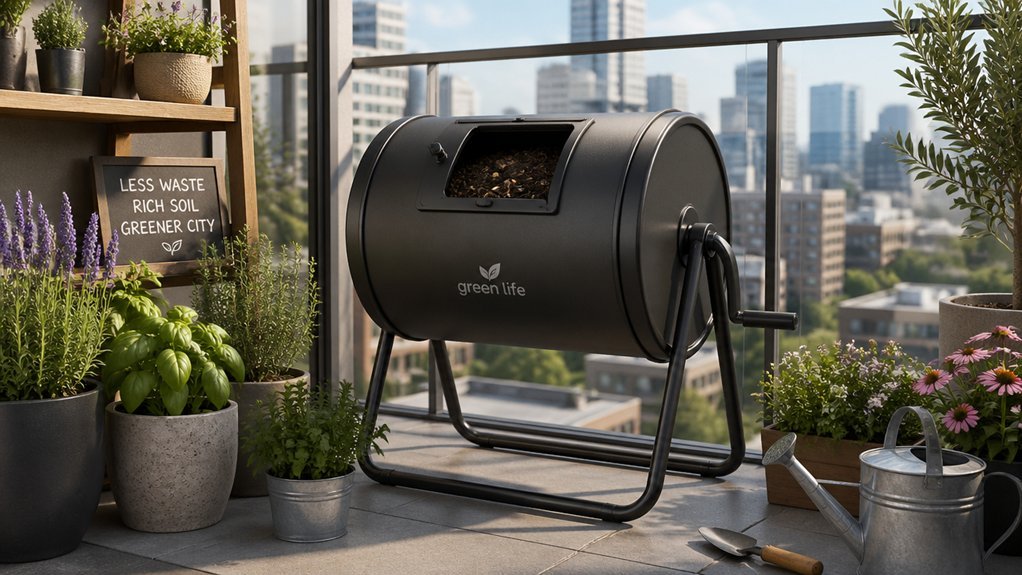
You can turn kitchen scraps into rich compost on a tight balcony with a compact, UV‑protected tumbling composter that fits a 19‑by‑23‑inch footprint and stands about 29 inches tall. Its dual‑chamber design rotates easily via a side crank, sealing odors with a rubber‑gasket lid and charcoal filter while internal mixing bars and aeration holes keep material moist and breathable. The lightweight, steel‑framed unit resists rain and sun, and you’ll find quick loading, simple maintenance, and fast 4‑6‑week decomposition—plus more details on choosing the right model and keeping it odor‑free.
Space‑Saving Tumbling Composters: Why They’re Perfect for Balconies

Ever wondered how you can turn a tiny balcony into a thriving compost hub? A tumbling compostper gives you exactly that. Its space‑saving design fits a balcony’s narrow footprint, standing about 29 inches tall while occupying just 23–24 inches in width. The dual‑chamber system lets you rotate the barrel with a crank or roll it on ground‑friendly wheels, so you never need a bulky installation. Black, heat‑absorbing plastic speeds up decomposition, and aeration holes plus internal mixing bars keep the material aerated. Lightweight UV‑protected plastic and a metal frame mean you can move it when you rearrange furniture. With capacities ranging from 18.5 to 65 gallons, you get efficient balcony composting without sacrificing precious floor space. Odor control filters play a role in maintaining hygiene and minimizing smells in compact setups.
Dimensions & Capacity of the Balcony Tumbler
The compact design that makes the tumbling composters perfect for balconies also defines the balcony tumbler’s dimensions and capacity. You’ll find it fits snugly into tight balcony dimensions while still handling a generous load. Its footprint measures 19.2 in L × 23.6 in W × 29.1 in H, and the steel‑framed, BPA‑free plastic body weighs only 11.2 lb. Inside, the tumbler offers an 18.5‑gallon (70 L) capacity, enough for a family’s kitchen scraps without crowding your outdoor space. 1. Length: 19.2 in – fits most railings. 2. Width: 23.6 in – leaves room for a potted plant. 3. Height: 29.1 in – tall enough for easy turning. This compact design maximizes utility while respecting your limited balcony real‑estate space optimization.
Balcony‑Ready Materials: Sun, Rain & Wind Resistance
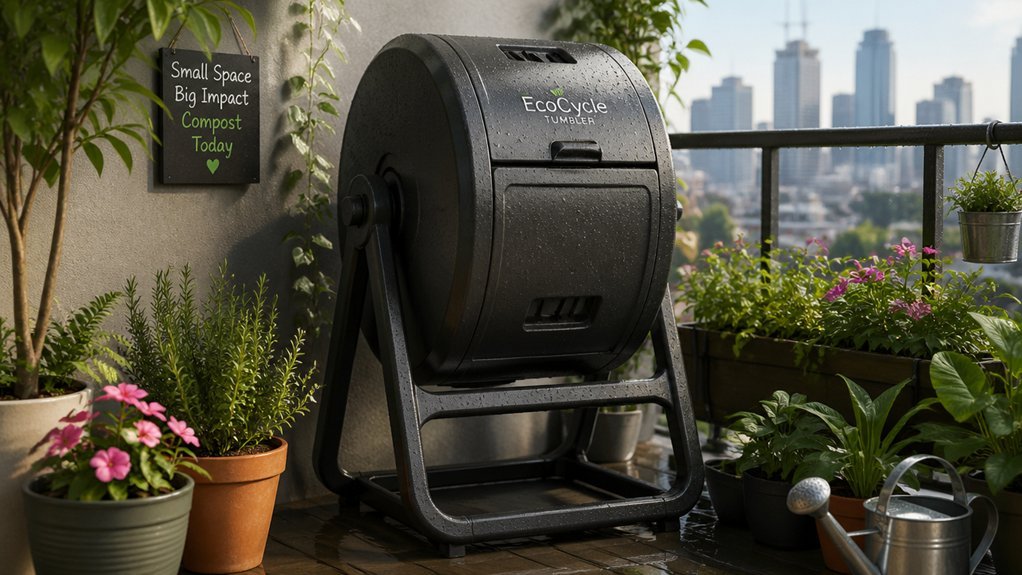
How can a compost tumbler survive harsh balcony weather? You’ll want a balcony‑ready design that endures sun, rain, and wind without cracking or rusting. Choose a tumbler built from BPA‑free plastic reinforced by a sturdy steel frame; the plastic is UV‑protected, so prolonged sunlight won’t make it brittle, and the steel resists corrosion from rain. Dark black panels absorb heat, keeping the compost warm while the UV‑resistant coating prevents fading. The sealed sliding‑door mechanism blocks wind and moisture, yet still lets you load and unload easily. By selecting these weather‑resistant, durable materials, you ensure your compost system stays functional year‑round on even the smallest balcony durable materials.
Balcony Compost Tumbler Rotation: Faster Compost in 4‑6 Weeks
You’ll notice how a quick, smooth spin speeds up decomposition, letting you see rich compost in just 4‑6 weeks. A standard rotation schedule supports consistent aeration and moisture balance for optimal results. GMP-certified quality considerations in enzyme-based accelerators can influence product reliability for safe home composting.
Rapid Rotation Boosts Speed
Ever wonder why a balcony tumbler can turn kitchen scraps into rich soil in just a month? You’ll find the secret in the rapid rotation that drives aeration and boosts speed. When you give the drum a quick, steady spin, oxygen floods the pile, microbes fire up, and heat builds fast. The result is a compost batch ready in 4‑6 weeks—much quicker than a static bin. Rotation helps maintain a steady airflow and moisture balance, supporting consistent breakdown. 1. Rotation – a smooth 30‑second turn every few hours keeps material moving. 2. Aeration – holes and mixing bars channel fresh air throughout the mix. 3. Speed – the combined motion accelerates microbial activity, cutting decomposition time dramatically. aeration benefits and the balance of airflow play a key role in odor control and efficiency.
Compact Design Fits Balconies
Looking for a compost solution that actually fits on a balcony? This space‑saving tumbler offers a compact footprint—just 19.2 L × 23.6 W × 29.1 H inches—so it slides onto railings or corners without crowding furniture. Its BPA‑free plastic shell and steel frame stay sturdy while the black powder coat resists rust, letting you compost in any weather. You’ll appreciate the sliding door for quick scrap drops and the easy‑turn mechanism that you operate 5–6 times a week. The 18.5‑gallon (70 L) capacity handles a typical kitchen waste stream, delivering ready‑to‑use fertilizer in 4–6 weeks. This design makes balcony composting practical, tidy, and efficient, turning limited outdoor space into a thriving mini‑garden.
Enhanced Aeration Reduces Time
Because the tumbler’s aeration holes and internal mixing bars constantly circulate oxygen, you’ll see the compost break down in just 4–6 weeks. The balcony tumbler’s design forces air through every layer, breaking up clumps and keeping microbes active. Faster airflow means shorter composting time, so kitchen scraps turn into dark, crumbly soil before the season ends. You’ll notice the black exterior absorbs heat, boosting microbial activity even on a modest balcony. To keep the rhythm, follow a simple turning routine: 1. Rotate the tumbler 5–6 times every few days. 2. Open the sliding door to add fresh material. 3. Check the aeration holes for blockages and clear them. Dual chamber design supports continuous processing and helps maintain steady aeration during turnover.
Balcony Aeration: Internal Bars & Air Holes
How does a balcony compost bin stay fresh and fast‑decomposing? You’ll find that the compact design of the tumbling unit packs a dual chamber inside a narrow footprint, perfect for a small balcony. Internal mixing bars stir the material while aeration holes line the walls, pulling fresh air through the compost and pushing out excess moisture. Those holes create a steady breeze that fuels aerobic microbes, so you avoid foul odors and slow breakdown. The bars break up clumps, exposing more surface area to oxygen, which speeds the process without adding bulk. Because the bin’s low profile resists wind‑induced tipping, you keep the aeration system working efficiently day after day, turning kitchen scraps into rich soil in weeks. The sturdy dual‑chamber design supports continuous processing, so you can feed new scraps while mature compost is curing continuous processing.
One‑Hand Loading, Turning & Frequency for Side‑Lock Design

A side‑lock compost bin lets you load, turn, and maintain it with just one hand, thanks to its sliding doors and a chamber that pivots smoothly. You’ll appreciate how the compact 29.1‑inch height and 23.6‑inch width fit a balcony while the side‑lock design keeps everything within reach. One‑handed loading feels effortless because the doors slide open wide, letting you drop scraps mid‑turn without juggling tools. Turning the chamber 5–6 times every few days keeps material aerated and speeds decomposition, yet the motion stays light enough for a single wrist.
- Slide the door open, drop in kitchen waste, close it.
- Grip the pivot handle, rotate the chamber.
- Repeat 5‑6 rotations every few days.
Balcony Odor & Pest Control Strategies
Even on a cramped balcony, you can keep your tumbling compost odor‑free and pest‑proof by sealing the bin tightly, using a well‑designed lid or sliding door, and adding simple barriers like fine mesh screens or a charcoal filter. Choose a model with a lockable door and airtight vent, then line the lid with activated charcoal to neutralize odor. Sprinkle a thin layer of shredded newspaper or dry leaves on top of the waste; it creates a dry barrier that deters ants, flies, and rodents. Keep the compost slightly moist, not soggy, and rotate the tumbler daily to maintain aerobic conditions, which further suppresses foul smells and attracts fewer pests.
| Feature | Benefit | DIY Tip |
|---|---|---|
| Tight‑fit lid | Blocks odor & pests | Install a rubber gasket |
| Charcoal filter | Absorbs smells | Replace every 2 months |
| Fine mesh screen | Stops insects | Use ½‑inch mesh |
| Locking sliding door | Secures contents | Add a simple latch |
| Dry top layer | Deters pests | Use newspaper or leaves |
Balcony vs. Apartment Compost Bin Choices
Which option fits your living situation better: a compact tumbling bin on the balcony or a larger stationary container inside the apartment? If you love fresh air and have a modest balcony, a space‑saving design lets you tumble waste without crowding the rail. A low‑profile, vertical tumbler fits 19–29 inches wide and stays under 30 inches tall, keeping the area usable for plants or chairs. If you’re inside, an apartment compost bin can sit on a kitchen counter or under a sink, but it requires more floor space and careful odor control.
- Balcony composting – vertical, portable, odor‑sealed.
- Apartment compost bin – larger, stationary, needs ventilation.
- Hybrid approach – start on the balcony, transition indoors when space permits.
Balcony‑Safe Compost Materials (What to Add & Avoid)
What can you safely toss into a balcony‑friendly tumbler? Start with kitchen scraps like fruit peels, vegetable trimmings, coffee grounds, and tea bags—they’re all compostable materials that break down quickly.
Add shredded newspaper, cardboard, or dry leaves to boost aeration and balance moisture.
Small amounts of grass clippings and garden trimmings work too, as long as they’re free of herbicides.
Avoid meat, dairy, oily foods, and pet waste; they attract pests and create odors.
Skip glossy paper, waxed cardboard, and diseased plants, which can contaminate the batch.
Keep the mix roughly 50 % greens and 50 % browns to maintain airflow and prevent sogginess.
Cleaning, Storage & Longevity Tips for Your Tumbler
How often should you clean your balcony tumbler to keep it humming? You’ll want a quick wipe after each compost cycle and a deeper clean every month. The sliding door lets you dump residue without hassle, and the aeration holes stay clear when you scrub them regularly.
Quick wipes after each cycle, deep clean monthly; keep sliding door open and aeration holes scrubbed.
- Empty and rinse – Open the sliding door, dump the finished compost, and rinse the interior with a garden hose.
- Scrub aeration holes – Use a soft brush to clear any blockage; this preserves airflow and speeds decomposition.
- Dry and store – Pat the bin dry, check the steel frame for rust, and keep the lid sealed when not in use.
Regular cleaning, proper storage, and inspecting the powder‑coated shell extend your tumbler’s longevity on a small balcony.
Top 5 Compact Tumblers for Balconies – Quick Comparison
You’ll love how each tumbler’s space‑saving design fits snugly on a balcony, with dimensions that won’t crowd your patio.
The easy rotation mechanism lets you turn the chamber a few times a week without hassle.
Compare the five models and see which one matches your compact‑living needs.
Space‑Saving Design
Ever wondered how a compact tumbler can fit on a narrow balcony without sacrificing composting power? You’ll love the space‑saving design that trims height and footprint while keeping the composter’s performance intact. A sleek 29.1‑inch tall, 23.6‑inch wide model slides into tight railings, and the tumbling bin style lets you turn waste manually—no bulky base or heavy lifting required. UV‑resistant BPA‑free plastic paired with a steel frame endures weather, and dual‑chamber or continuous‑flow layouts keep the process smooth in a smaller form factor.
- Height‑optimized frame
- Narrow‑footprint base
- Weather‑proof material combo
These three traits let you maximize composting on any balcony, no matter how constrained the space.
Balcony‑Friendly Dimensions
Looking for a tumbler that truly fits a narrow balcony? This balcony-friendly compost tumbler measures 19.2 L × 23.6 W × 29.1 H inches, so it slides into tight railings without crowding plants or furniture. Its 18.5‑gallon (70 L) capacity lets you process kitchen scraps and yard waste while staying compact. A BPA‑free plastic shell, solid steel frame, and black powder coating keep it rust‑resistant and lightweight at 11.2 lb. Aeration holes and internal mixing bars promote fast decomposition, and the side‑locking mechanism simplifies loading. These dimensions make the unit ideal for balconies, patios, or corridors where space is at a premium, delivering efficient composting without sacrificing room.
Easy Rotation Mechanism
One of the most critical features for a balcony tumbler is an easy‑rotation mechanism that lets you spin the drum without straining yourself or taking up extra floor space. You’ll appreciate a side‑mounted crank that stays within reach while you stand on a narrow balcony, and the design should keep the tumbling action smooth even when the load is heavy. Aeration holes in the drum walls work with the crank to promote airflow, speeding up decomposition without extra effort.
- Central crank – offers balanced leverage, ideal for compact frames.
- Side crank – fits tight corners, lets you turn the drum from a standing position.
- Dual‑handle crank – combines comfort and control, perfect for uneven balcony surfaces.
These mechanisms keep your compost moving efficiently while preserving precious floor space.
Frequently Asked Questions
Do Tumbler Composters Really Work?
Yes, they work—just load your kitchen scraps, keep the mix moist, turn the drum regularly, and you’ll see hot, aerated compost breaking down faster than in static bins.
Can You Have a Compost Bin on a Balcony?
Yes, you can place a compost bin on a balcony; just choose a compact, odor‑controlled tumbler, secure it against wind, keep it aerated, and empty it regularly to avoid mess.
How to Compost in an Apartment Balcony?
You’ll start by choosing a compact tumbler, add shredded kitchen scraps and a bit of soil, keep it moist, turn it weekly, and use a vented lid to control odors while it decomposes.
Does a Compost Tumbler Attract Rodents?
Yes, a compost tumbler can attract rodents if it lacks a tight lid or secure door, but choosing a model with snug‑fitting closures, elevated stand, and mesh‑screened ventilation will keep critters away.
In Summary
You’ve seen how a compact tumbling composter fits snugly on a balcony, handles weather, and turns kitchen scraps into rich soil in just a few weeks. With the right material choices, regular rotations, and simple cleaning, you’ll keep the process hassle‑free and odor‑free. Pick a sturdy, space‑saving model, follow the safe‑material guide, and enjoy fresh compost without sacrificing precious balcony real.