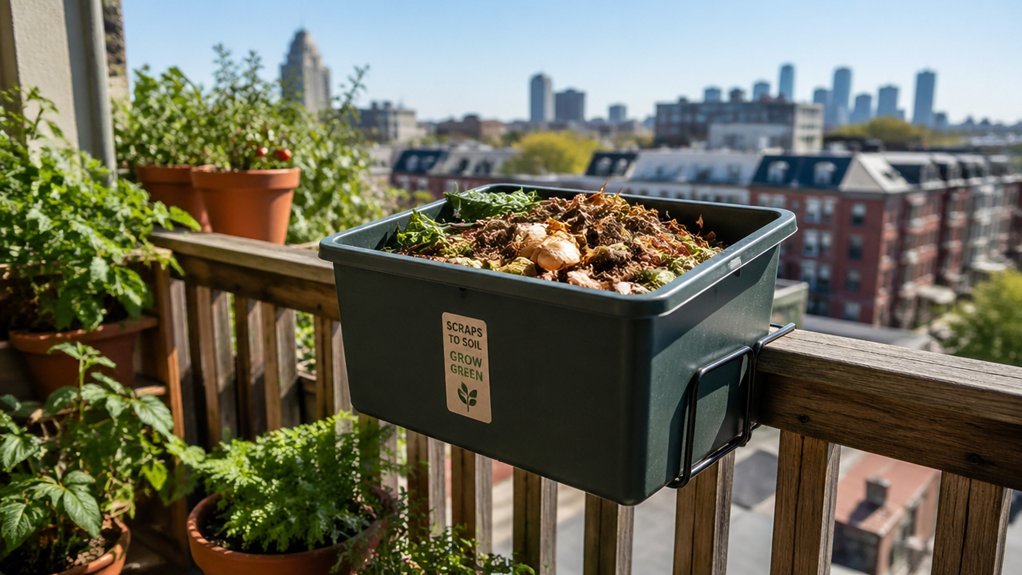
Aim for a balcony compost bin about 60–75 cm (24–30 in) tall. This height lets you stir, turn, and check moisture without bending or a stool, keeping the unit stable and within arm’s reach. It also provides enough space for airflow and drainage, reducing odor and heat buildup. Staying under 90 cm fits most balcony railings and leaves room for other plants, and the design can be adapted for vermicomposting, Bokashi, or two‑bucket systems if you want to explore more options.
What Is the Ideal Height for a Balcony Compost Bin?
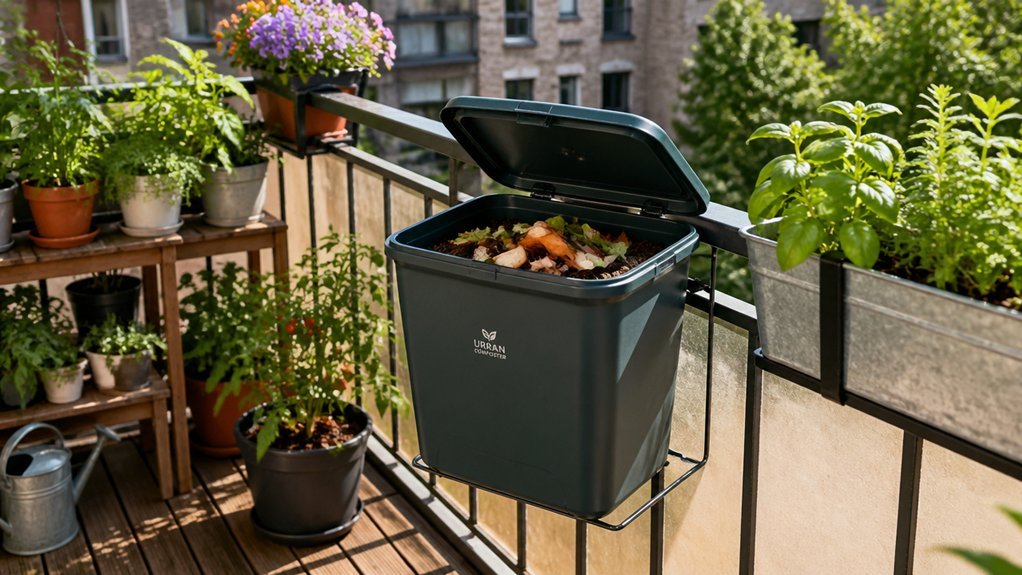
What’s the sweet spot for a balcony compost bin? You’ll find that a compost bin height of 24 to 30 inches (60‑75 cm) hits the sweet spot. At this range you can stir, turn, and check moisture without bending too far or pulling a stool. For best results, ensure the design keeps a stable base and uses a sturdy handle to manage mobility on a small balcony while preventing spills and tipping height optimization. Anything under 18 inches forces you to crouch, while exceeding 36 inches—especially over 3 feet—traps air, slows decomposition, and makes aeration tricky in a cramped balcony. Keep the bin within arm’s reach; you’ll reduce strain and avoid ladder mishaps.
If you choose a vertical or stacked design, lift the base a few centimeters off the floor to let excess water drain away. This height balance gives you easy access, efficient airflow, and steady compost activity.
Which Compact Balcony Compost Designs Fit Small Spaces?
Ever wondered which compact compost setups can thrive on a cramped balcony? You can choose a vermicomposting bin that fits under the railing, keeping the height low and odor minimal. Bokashi kits work well in high-rise apartments; they’re dense, sealed, and emit almost no smell, making them perfect for tight spaces. If you want a dual-purpose design, try a two-bucket-inside-a-mortar-trough system: the trough stays low, doubles as a planter, and the buckets swap when one fills. All three options stay well beneath typical balcony heights, maintain airflow, and keep maintenance easy. By selecting one of these compact balcony composting solutions, you’ll turn limited square footage into a thriving, low-profile recycling hub. odor control
How Does Bin Depth Influence Airflow for Balcony Compost?
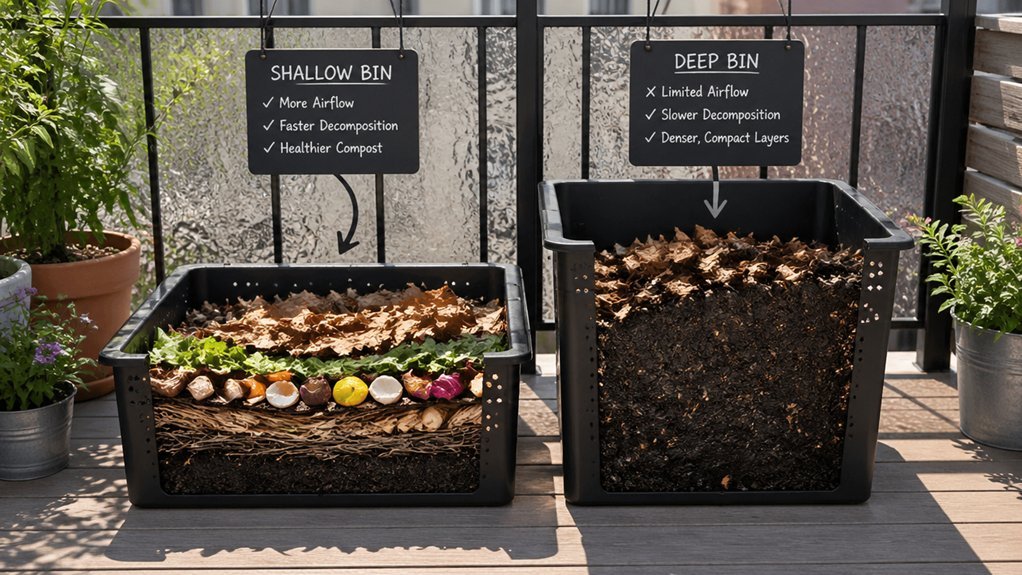
You’ll notice that a bin depth of about 2.5–3 feet lets air circulate well without choking the pile, while deeper bins can trap oxygen and slow down composting.
Shallow bins boost surface‑to‑volume exchange, so microbes stay active even on a breezy balcony.
Adding side and bottom vents, especially on cylindrical containers, helps keep airflow uniform and odors in check.
Dual-chamber design considerations help maintain continuous composting by separating active compost from curing mass, enhancing overall aeration and efficiency.
Bin Depth and Airflow
How deep should your balcony compost bin be to keep air moving? Aim for 1–1.5 feet; this shallow depth maximizes surface exposure and lets oxygen flow through the material without needing excessive vents.
Deeper bins can trap heat but they squeeze airflow, so you’ll need extra side or bottom vents and more frequent turning to avoid stale pockets.
Install a few ½-inch holes at the lower sides and a drainage slot at the bottom; this arrangement creates a steady draft that pulls fresh air in and pushes CO₂ out.
Remember, turning the pile every few days is more essential than depth alone—mixing restores airflow, balances moisture, and prevents odor. P-4 security
Optimal Height for Balconies
Why does bin height matter for balcony composting? You’ll find that a composting height near 3 feet (≈90 cm) gives you the sweet spot between aeration and turning ease. At that level, airflow sweeps through the pile, keeping decomposition brisk and odors low. If you go taller, the interior mass can stagnate, slowing oxygen diffusion and raising heat—bad news for a cramped balcony. Uniform 3 ft × 3 ft × 3 ft units also let you rotate sections without hassle, preserving consistent airflow. Match the bin’s depth to your railing’s space; a moderate depth prevents heat buildup while still holding enough material. By respecting these dimensions, you maintain accessible aeration paths and avoid crowding, ensuring a healthy, efficient composting height on your balcony. Also, compact, odor-controlled models from compact grinders for indoor composting can help maintain a tidy balcony space odor control while processing kitchen scraps efficiently.
What Moisture Controls Keep Balcony Compost Odor‑Free at 60‑90 cm?
Ever wondered how a small balcony bin stays fresh without a stench? You keep moisture in check by treating the mix like a well‑wrung rag—damp but not soggy. Add equal parts green scraps and brown leaves; the dry material soers excess water while the greens supply needed moisture. Turn or stir the pile daily to introduce airflow, which stops anaerobic conditions that cause odor. Drill holes in the bin and use a lid that lets air escape yet keeps rain out, so excess moisture vents safely. If a smell surfaces, sprinkle more brown leaves or wood chips, mix them in, and let the pile dry back to the right texture. This balance maintains a scent‑free compost at 60‑90 cm, with containers and liners that are compatible for balcony setups and help manage moisture and odors effectively airflow management.
How to Set Up a 60‑90 cm Balcony Compost Bin Without Odor?
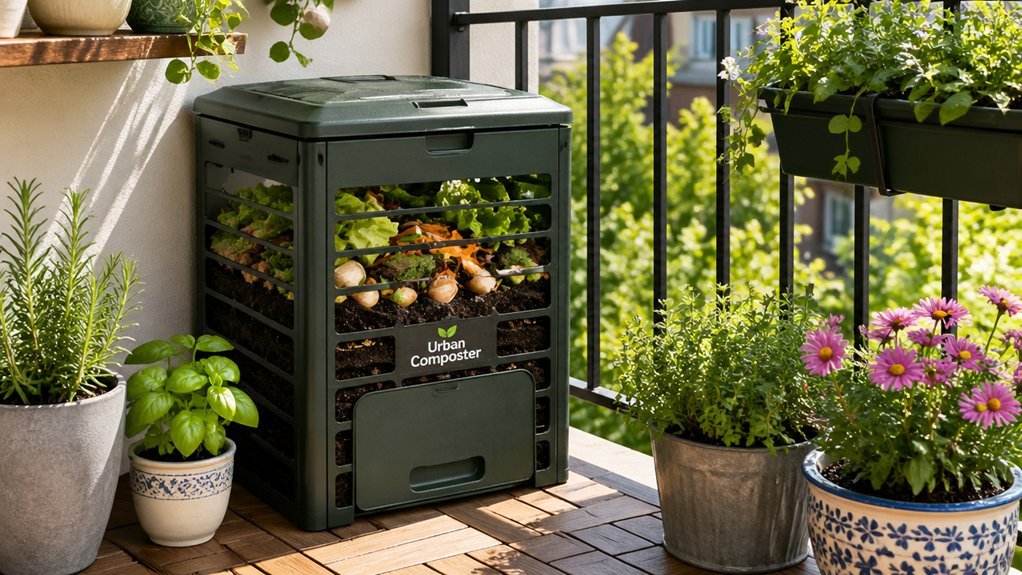
Wondering how to keep a 60‑90 cm balcony compost bin odor‑free? First, set the bin on a stable, non‑slip surface and add a drip tray underneath to catch leachate. Drill side and bottom holes for airflow, then layer 40 % green and 60 % brown material to balance moisture. Turn the pile gently once a week and never toss oily foods or soggy scraps. Regular checks keep the compact pile dry and aerobic, preventing the strong smells that plague high‑rise balconies. Maintaining proper jar compatibility and design considerations helps ensure the system stays efficient and easy to clean food‑safe materials.
Do Different Balcony Compost Methods Need Different Heights?
You’ll notice that vermicomposting bins work best at waist‑to‑chest height so you can turn them easily, while Bokashi or bucket‑in‑tray setups can sit lower to keep the balcony looking tidy.
Your balcony’s space constraints will dictate whether you can afford a taller, three‑foot arrangement that boosts airflow, or need a compact, low‑profile unit.
Remember that proper height helps balance aeration and odor control, especially for worm farms that thrive at hip level.
Method Height Requirements
Since balcony compost setups vary, the optimal height depends on the method you choose. For vermicomposting, keep the composting height low—ground level or a sturdy stand—so worms stay active and you can monitor moisture without straining.
Bokashi units work well at countertop or bench height, roughly 3–4 feet, which curbs odors and lets you tap the sealed bags comfortably.
Two‑bucket or trough‑style systems typically sit 1–2 feet tall, balancing aeration, leachate control, and space efficiency.
A low‑profile design under 1.5 feet reduces wind exposure and tipping risk while still allowing easy turning and harvest.
Adjust the height within these ranges to match your chosen method, ensuring airflow, accessibility, and stability on your balcony.
Space Constraints Influence
When space is tight, the compost method you pick dictates the ideal height. You’ll notice that compact vermicomposting bins stay under 2 feet, while stackable troughs push the composting height to 2–3 feet to keep floor space free. A two‑bucket‑in‑a‑mortar setup lands around 2–2.5 feet, giving you easy reach for feeding and turning without crowding the balcony. If you use a spray or drip system, raise the unit just enough (about 1–2 feet) to catch leachate without overflow. Choosing the right design lets you stay within a practical composting height and maximizes usable space.
- Vermicomposting bins – 1–2 ft tall.
- Stackable/trough systems – 2–3 ft tall.
- Two‑bucket‑in‑mortar – ~2–2.5 ft tall.
Airflow and Odor Control
Wondering whether compost height matters for airflow and odor? You’ll find that a modest height—usually under 1 meter—keeps oxygen flowing and moisture from pooling, which is key for ventilation and odor control. Worm bins thrive at this level because the pile stays moist but not soggy, while three‑bin turning units need a 3 ft × 3 ft × 3 ft footprint to preserve aeration regardless of balcony clearance. Drilled‑hole containers and bottomless buckets need enough vertical space for air pockets and leachate drainage, so avoid compacting the pile. Elevating the whole system a few inches above the railing encourages convection, reduces surface moisture, and further improves ventilation.
| Method | Ideal Height | Ventilation Feature |
|---|---|---|
| Worm bin | < 1 m | Mesh walls, regular turning |
| Three‑bin turner | 3 ft × 3 ft × 3 ft | Open top, side vents |
| Drilled‑hole container | ≥ 30 cm | Perforated sides, bottom tray |
| Elevated stand‑alone | 5–10 cm above floor | Convection boost, airflow gap |
Frequently Asked Questions
Can I Compost on a Balcony?
Yes, you can compost on a balcony by choosing a compact worm bin or Bokashi system, keeping it well‑ventilated, moisture‑balanced, and using a lid with holes to control odors and pests.
What Are Common Composting Mistakes?
You often over‑water, neglect aeration, pile too many greens, ignore drainage, and forget to turn the pile; these mistakes slow decomposition, create odors, attract pests, and ruin your balcony compost.
Do Potato Peelings in Compost Attract Rats?
Yes, exposed potato peels can draw rats, but if you seal them in a compostable bag, balance browns and greens, and keep the bin covered and well‑aerated, you’ll prevent infestations.
How Tall Should Compost Be?
Keep your compost pile under three feet tall—ideally around two feet—so it stays aerated, cool, and manageable on a balcony. This height prevents compaction, promotes decomposition, and reduces odor and pest risks.
In Summary
You’ve learned that a 60‑90 cm height balances space, airflow, and moisture control, keeping your balcony compost odor‑free and efficient. Choose a compact design that fits your railing, ensure the bin’s depth promotes ventilation, and monitor moisture to avoid smells. By setting up the bin at this ideal height, you’ll turn kitchen scraps into rich soil without compromising your balcony’s aesthetics or comfort.